
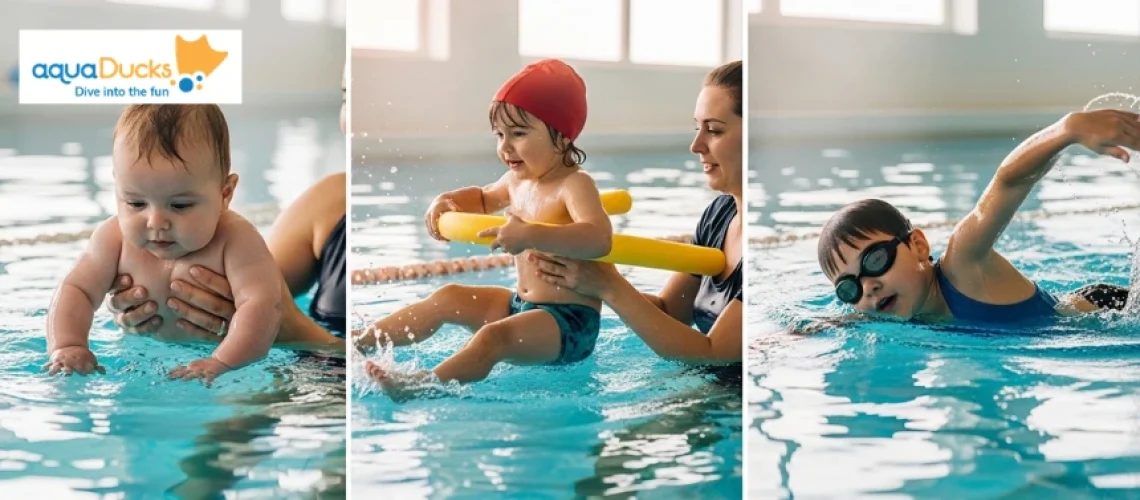
When should you actually start swimming lessons for your child?
This is one of the first questions parents in Singapore ask, and honestly, there is no single right answer. Every child develops differently, and what works for one child may not suit another.
What most parents do not realise is that swimming introduction can begin much earlier than they expect. And waiting too long is rarely the problem. The bigger issue is starting in the wrong programme for the wrong age, which can make a child feel overwhelmed or lose interest before they have even properly begun.
This expert’s guide breaks down each age stage clearly so you know exactly what to expect, what your child will learn, and when the timing makes sense.
Why Early Swimming Matters in Singapore
Singapore is surrounded by water. Pools, beaches, and open waterways are part of daily life here, and water safety is a genuine concern for families across the country.
Children who are introduced to water early are less likely to develop fear around it. They build a comfort with the pool environment that makes formal lessons much easier when they begin. Beyond safety, early swimming also supports physical development. Moving through water strengthens muscles, improves coordination, and builds motor skills in ways that are hard to replicate on land.
There is also a confidence factor. Learning to do something physically challenging at a young age gives children a sense of achievement that carries into other areas of their life.
Best Age to Start Swimming Lessons: Stage by Stage
Infants (4 to 5 Months Old)
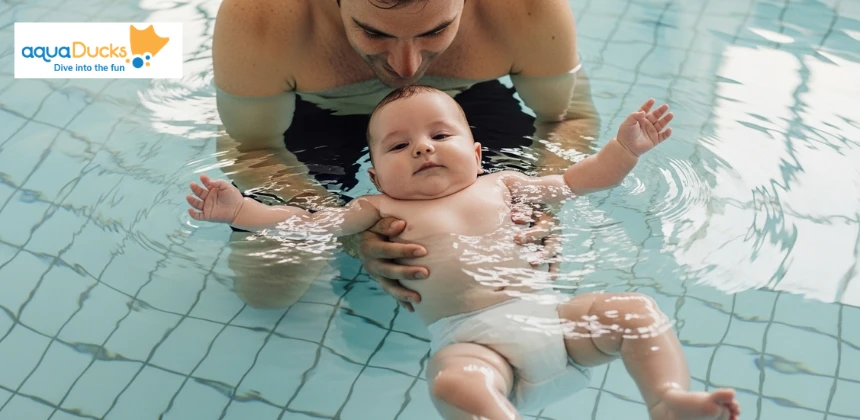
Most parents are surprised to hear that infant swimming lessons can begin as early as four months. To be clear, this is not swimming. It is simply giving your baby their first gentle experience in water so the pool feels familiar rather than scary.
Sessions at this age are short, around 20 minutes, and always parent-assisted. One parent stays in the water with the baby throughout. The pool should be warm and the environment calm.
Babies at this stage experience gentle movement through the water, simple kicking with support, and sensory activities like songs and bubbles. There is no submersion and no pressure. The only goal is a positive early association with water.
Not every baby will take to it immediately, and that is fine. Some fuss in the first session or two before settling. Consistency matters far more than how the first lesson goes.
Babies and Toddlers (6 to 35 Months Old)
This is where early skill building genuinely begins. Children between six months and 35 months are curious, physically active, and starting to respond to simple instructions, making this a great window for structured water exposure.
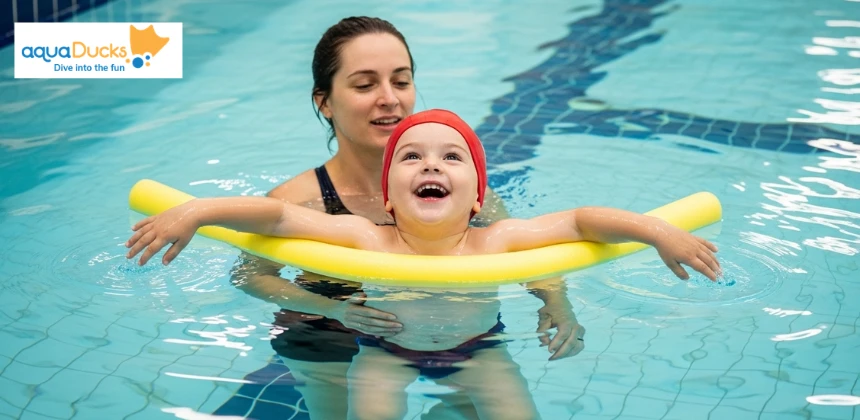
Lessons remain parent-accompanied at this stage. A parent or caregiver joins the child in the pool, which helps children feel secure and mirrors the calm they need to explore confidently. Classes are 30 minutes with small group sizes.
For babies between six and twelve months, lessons focus on water exploration, pre-submersion exercises, supported kicking, blowing bubbles, and gradually getting comfortable with having the face and head wet.
For toddlers between thirteen and 35 months, lessons move into more active skills. Children learn to jump from the pool edge with support and swim back to the wall, which is an important early safety skill. They also begin back floating, rhythmic breathing, swimming short distances underwater, and retrieving objects from the pool floor.
Progress at this age is rarely linear. Toddlers absorb, plateau, and then leap forward. Missing a few sessions can sometimes feel like starting over, which is why regular attendance makes such a difference.
If you’re looking for a structured start, Aquaducks offers parent-assisted baby and toddler swimming lessons from 6 months, helping little ones build water confidence through gentle, play-based exploration in a safe and supportive environment.
Preschoolers (3 to 4 Years Old)
Ages three and four are considered one of the most effective windows for learning foundational swim skills. Children at this stage can follow multi-step instructions, participate in structured activities, and start building real technique in the water.
Lessons are 30 minutes with a small child-to-instructor ratio. Early levels are still parent-assisted, but one of the key milestones at this stage is the transition to independent classes, where children swim without a parent in the water. This is a big confidence moment for most kids.
Through a structured six-level programme, preschoolers progress from basic water exploration all the way through to swimming freestyle independently over ten to fifteen metres. Along the way they learn complete submersion, gliding, flutter kick, rhythmic breathing, back floating, safe pool entry and exit, and retrieving objects from the pool floor.
By the end of this stage, a child who has worked through all the levels is swimming on their own. That is a significant achievement at this age and builds real confidence both in and out of the pool.
Children (5 Years and Above)
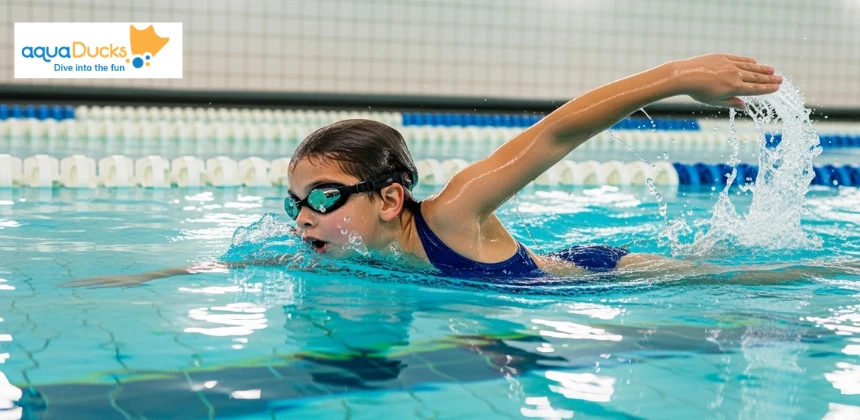
From age five, children are ready for proper structured swim training. They can follow technical instruction, sustain focus for 45-minute sessions, and begin learning all four major swimming strokes with correct form.
This stage is where swimming shifts from water familiarity to genuine swimming ability.
Children new to swimming at age five begin with foundational levels covering breath control, floating, gliding, and basic kicks before moving into stroke development. From there, they progress through stages covering Freestyle, Backstroke, Breaststroke, and Butterfly, alongside survival skills like water treading, straddle entry, and underwater recovery.
According to Sport Singapore, SwimSafer is the national swimming standard and is a mandatory part of the curriculum for all Primary 3 students in Singapore. A well-structured swim programme will align its lessons with SwimSafer stages so children are naturally prepared for the assessment without extra coaching. The certification is recognised by all schools in Singapore and is a meaningful marker of a child’s swimming competency.
With consistent attendance of one to two sessions per week, most children aged five can swim ten metres within three to four months. Completing all foundational levels through to stroke mastery typically takes until around age eight with regular practice.
Older Children (9 Years and Above)
For children who have already completed a full learn-to-swim programme and want to push further, a Stroke and Development programme is the next step. This is not for beginners. It is designed for children who already swim competently and are ready to work on technique refinement, endurance, and advanced water safety skills.
Sessions run for 45 to 60 minutes across three progressive levels. Children work on all four strokes over significantly longer distances, with a focus on correct race starts, turns, and finishes.
Across the three levels, children develop:
- Freestyle, Backstroke, Breaststroke, and Butterfly over distances up to 400 metres
- Individual Medley up to 200 metres
- Treading water in full clothing
- Dry rescues using poolside equipment
- Underwater swimming and improvised floating aids
- Water safety knowledge assessed at each level
What makes this stage different from earlier levels is how much emphasis is placed on real-world survival. A child who completes this programme does not just swim well. They understand how to keep themselves and others safe in the water. Most children who start at nine complete all three levels within one to two years with regular attendance.
Is It Too Late If Your Child Has Not Started Yet?
No. This is one of the most common worries parents bring up and the answer is straightforward. Older children actually tend to pick up foundational skills faster than younger beginners. A seven or eight year old who has never swum before can reach basic water competency within a few months of regular lessons, simply because they understand instructions better and can apply corrections faster than a younger child.
What matters is placing your child in the right level for where they currently are, not where you feel they should be for their age. Starting later with the right programme and a good instructor is far better than starting early in the wrong environment.
Signs Your Child Is Ready to Start
Age is a useful guide but readiness also depends on the child. Look for these signs before enrolling:
- They are calm or curious during bath time
- They show interest when they see a pool or other children swimming
- They are willing to step into shallow water with your support
- They can follow simple instructions like kick, hold, or blow bubbles
- They recover quickly when water splashes on their face
If your child is afraid of water, do not rush into lessons. Start with water play at home, gradually introducing more exposure before joining a class. A good instructor will know how to work with anxious children, but coming in with some prior positive experience helps.
How to Prepare Your Child for the First Lesson
A little preparation before the first session makes a big difference for both parent and child.
Bring a comfortable swimsuit, towel, goggles for children three and above, and a swim diaper for younger ones. Arrive around ten minutes early so your child can look around and get comfortable with the environment before the class begins.
Give your child a light meal at least 30 to 45 minutes before the session, not immediately before. Avoid going on an empty stomach either.
Once poolside, stay calm. Children pick up on parental anxiety very quickly, and your relaxed presence gives them confidence. Avoid comparing your child to others in the class, and do not force or bribe them into the water. Let the instructor guide the pace. That is what they are trained to do.
How to Choose the Right Swim Programme
The programme you choose shapes how your child feels about water long term. A well-matched programme builds confidence while a poorly matched one can create anxiety that takes time to undo.
When looking at swim schools in Singapore, check that instructors are certified and experienced with children across different age groups. Look for small class sizes that allow individual attention, heated indoor pools, a clear level-by-level curriculum, and the option to do a trial class before committing.
AquaDucks has been running structured swimming programmes for children in Singapore since 1989, with age-appropriate classes from four months all the way through to advanced stroke development for children nine and above. Our programmes are aligned with SwimSafer standards and run across multiple locations island-wide.
Book a trial session with AquaDucks
Conclusion
There is no single age that works for every child when it comes to starting swimming lessons. Some children begin as early as four months with gentle water exploration. Others start as toddlers through play-based sessions, while older children are ready to learn proper strokes and build real swimming independence.
What matters most is matching your child to the right stage at the right time, without pressure and without comparison. A child who starts at the correct level, in a supportive environment, will always progress faster than one who is pushed too early or placed in a class that does not suit where they are.
Swimming is a life skill that stays with a child forever. The best time to start is simply when your child is ready to take that first step into the water.
Frequently Asked Questions
How long does it take a child to learn to swim?
With regular attendance of one to two sessions per week, most children who start at age five can swim ten metres within three to four months and complete all levels by around age eight.
What is SwimSafer and why does it matter?
SwimSafer is Singapore’s national swimming certification programme recognised by Sport Singapore. It is mandatory for all Primary 3 students and is accepted by all schools in Singapore as a formal measure of swimming competency. A good swim school will align its curriculum with SwimSafer stages.
Should I choose group or private swimming lessons?
Group lessons work well for most children and offer peer motivation and structured progression. Private lessons are better for children who need extra support, have water anxiety, or are working on a specific technique. Many families use both at different stages.
What should my child bring to the first swimming lesson?
A swimsuit, towel, goggles for children three and above, a swim diaper for younger children, and a change of clothes. Arrive a few minutes early and make sure your child has had a light meal at least 30 minutes before the session.