
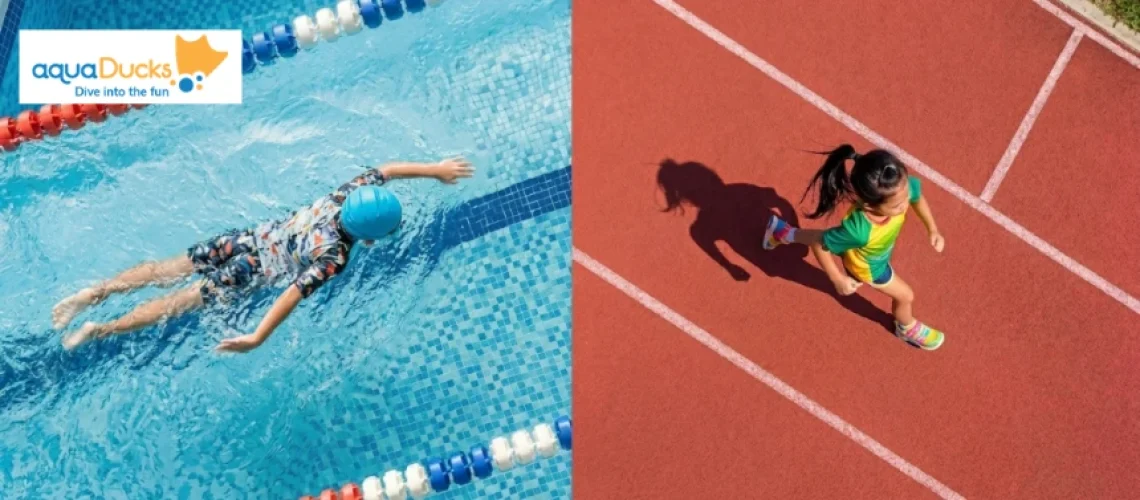
Every Singapore parent hits this moment. Your child comes home full of energy, the tablet is sitting right there, and you are trying to figure out the better option. Swimming vs running for kids is not as straightforward as it sounds. Both are good and easy to find across the island, but they are not the same, and they do not work the same way for every child.
Get it right, and your kid builds a habit that sticks for life. Get it wrong, and you are a few months in, out of pocket, and watching your child make excuses to skip every session. Singapore’s weather can derail a running routine faster than you expect, and a packed pool schedule can quietly drain your wallet before you notice the results.
This guide covers the whole picture, from toddlers just getting comfortable in the water all the way to teenagers training for school competitions. By the end, you will know exactly which sport is right for your child and when.
What Each Sport Actually Does For Your Child: Body And Mind
Most parents pick a sport based on what their child enjoys in the moment. That is a good start, but it is worth knowing what is actually happening inside your child’s body every time they train. Research suggests that both swimming and running rank among the most effective forms of exercise for cardiovascular health in children, though they get there in very different ways.
What Swimming Does For Your Child
- Builds strength across the whole body, arms, legs, and core, all working together at once
- Improves lung capacity and breathing control, the more your child gets in the water
- Develops sharper coordination and body awareness that carries over into other sports naturally
- Has a calming effect on most children that other activities rarely match
What Running Does For Your Child
- Strengthens the legs and core while building denser bones because the body works against gravity with every stride
- Grows cardiovascular endurance fast, showing up quickly in energy levels and stamina throughout the day
- Teaches kids to push through discomfort, building a kind of mental toughness that shows up well beyond the track
- Grows in quiet confidence session by session, which tends to carry over into classrooms and sports days too
Swimming Vs Running: How Do They Compare?
Most parents searching for swimming or running for their child in Singapore are really asking the same thing: which one will actually make a difference? Here is how both sports stack up across the factors that matter most.
1. Cost
Swimming: You are investing in a proper programme with qualified coaches and a clear path forward at every stage. Most parents find it money well spent once they see how quickly their child progresses and how much their child looks forward to each session.
For a full price breakdown, check out our guide on swimming lesson costs in Singapore.
Running: Pretty much free once you have a decent pair of kids’ running shoes sorted. No monthly fees, no booking slots, just lace up and go whenever works for your family.
2. Weather Suitability
Swimming: Indoor pools are unaffected by whatever is happening outside. Rain, heat, haze, none of it changes whether your child’s session happens.
Running: Heat between 11 am and 5 pm is genuinely tough on young kids, and haze days make it worse. Early mornings work best, and spots like East Coast Park and MacRitchie Reservoir are popular for exactly that reason. Getting there before 8 am is not always realistic for families juggling school drop-offs and work.
3. Safety And Injury Risk
Swimming: Low injury risk overall. The water supports the body throughout, and qualified instructors reduce the chance of your child picking up bad technique that causes strain later.
Running: Generally safe with the right precautions. The most common issues in young runners are knee and ankle strain from poor footwear or doing too much too soon. Starting gradually and investing in proper shoes keeps this risk low for most children.
4. Social Benefits
Swimming: Group classes build a real sense of community. Kids progress through levels together, celebrate each other’s milestones, and often form friendships that last well beyond the pool.
Running: Running clubs, school cross country teams, and fun runs give children plenty of social opportunities too, teaching pacing, encouragement, and shared effort in a way solo training cannot.
5. Age To Start
Swimming: From age one with water familiarisation classes. Starting early tends to pay off because comfort in the water makes proper technique click faster later on.
Running: Better suited from around age five, once coordination and balance have developed enough for regular training to feel natural rather than forced.
6. Mental Benefit
Swimming: Children who struggle with focus, restlessness, or anxiety often respond surprisingly well to time in the water.
Running: Builds a quiet toughness that is hard to define but easy to notice once a child has been running regularly for a while.
Swimming Vs Running: A Quick Comparison
| Factor | Swimming | Running |
| Calories Burned (30 min) | Roughly 200 to 300 for a child, depending on intensity | Roughly 250 to 350 for a child, depending on pace |
| Skill Learning Curve | Slower to start, the technique takes time to build | Quick to pick up, most kids can run from day one |
| Competition Pathway | SwimSafer, club meets, school swim teams | School cross country, track and field, and fun runs |
| Safety | Requires supervision and instruction at every stage | Requires supervision but lower technical risk |
| Weather | Unaffected, indoors all year | Limited by heat and haze |
| Cost | Structured programme with ongoing fees | Free beyond a good pair of shoes |
How To Fit Swimming Or Running Into A Busy Singapore Family Schedule
Benefits and comparisons are one thing. Fitting a sport into a real family week is another. School schedules, CCA commitments, and exam periods all compete for the same limited hours, and the sport that survives all of that is usually the one set up thoughtfully from the start.
Fitting Sessions Into A School Week
Two to three sessions a week is the sweet spot for most kids. Go beyond that early on, and children burn out faster than expected. Drop below it and progress slows enough that kids lose interest. Pick fixed days, stick to them, and keep going even during exam periods, since staying active during exams tends to improve focus rather than add to the pressure.
Can My Child Do Both?
Absolutely, and for many families in Singapore it is the ideal setup. Swimming builds the strength and breathing control that makes running feel easier, and running builds the endurance base that carries over well into the pool. One programme alongside one or two easy runs a week is enough to build a well-rounded young athlete without overloading them.
Which Is Better At Different Ages: Toddlers To Teens
Every child is different, but age plays a bigger role in this decision than most parents realise. What works brilliantly at two looks very different at twelve, and the sport you start with does not have to be the one you stick with forever.
1. Ages 1 To 3: Start In The Water
Toddlers are not ready for running, but they are absolutely ready for water. This is the best age to build water confidence through baby and toddler swimming lessons. It is not about technique yet, it is about building a relationship with water before any fear has a chance to set in.
2. Ages 3 To 5: Build On That Foundation
Once early comfort is there, this is the age to move into preschool swimming lessons. Coordination and listening skills are developed enough for basic strokes and water safety. Running is fine for free play but structured training is still a few years off.
3. Ages 6 To 9: Start Exploring Both
Running becomes a genuinely viable option alongside swimming here, since most kids this age have the coordination and attention span for both. A weekend family jog or a school fun run is plenty to start with. Keep swimming as the anchor and let running grow around it.
4. Ages 10 To 12: Build Serious Habits
Children are ready for more structured training in either sport by this age. School CCAs and competitions start becoming relevant, and the habits formed now tend to shape how active a child stays as they get older.
5. Ages 13 And Above: Train With Purpose
Teenagers can handle more volume and intensity in either sport, and cross-training becomes genuinely valuable. A teen swimmer who runs twice a week builds fitness that shows up in their pool times. For teens ready to take swimming seriously, competitive swim training builds the technique, endurance, and race preparation needed at this level. A teen runner who swims regularly recovers faster and stays injury-free for longer.
Curious about the right age to start? Read our full guide on the best age to start swimming lessons for babies, toddlers, and kids.
Conclusion
If your child is a toddler, swimming is the clear choice. Water confidence built early is one of the most valuable things you can give a young child, and Singapore makes it easy to start early and do so properly.
As your child grows, the picture changes. Running earns its place from around age five, and by primary school, both sports bring something valuable to the table in their own way.
So, is swimming better than running for kids? For the youngest children, yes, without much debate. Past that age, each sport strengthens the other, and most families end up with happier, fitter kids when both get a place in the week.
It is swimming first, and running when your child is ready.
Ready to get your child started? Aquaducks is a trusted swim school in Singapore, known for experienced instructors and a structured approach to every age group. Whether your toddler is just getting comfortable in the water or your teenager is training for competition, there is a program built for exactly where they are.
FAQs
How long does it take for a child to learn to swim in Singapore?
It depends on age and consistency. Toddlers who begin with water familiarisation tend to swim independently within their first couple of years. Children starting at five or six often get there within a few months of regular lessons. Two consistent sessions a week will generally outpace irregular practice.
Should my child run before or after swimming lessons?
After is generally better. Swimming uses the upper body and core heavily, and a proper swim session leaves most children tired enough that running beforehand would affect their technique and focus in the water. A short easy run after lessons works well as a cooldown activity, especially for older children who can handle both in the same outing.
How do I know if my child is ready for swim school?
If your child is comfortable around water and can follow simple instructions, they are likely ready. Most schools in Singapore welcome children from age one with parent-accompanied classes. You do not need to wait until your child can already swim. That is exactly what swim school is for.
Does running affect a child’s growth plates?
This is a common concern but low risk when running is age-appropriate and not overdone. Growth plate injuries in young runners are usually caused by too much too soon, not running itself. Keeping sessions short, increasing distance gradually, and making sure your child is not in pain after runs are the main things to watch for.
Can kids with ear problems swim regularly?
In many cases, yes. Swim caps and good-quality earplugs offer solid protection for regular sessions. For children with grommets or recurring infections, a quick check with your doctor first is a sensible step.