
You pushed off the wall, took your first few strokes, and then your lungs gave up before your legs did.
Sound familiar? Most swimmers hit this wall early. It’s not about being unfit. It’s not about being bad at swimming. It’s just that nobody ever taught you how to build swimming endurance, and that part makes all the difference.
Swimming endurance is simply how long you can keep going without stopping. The thing is, it’s a skill, not a talent. You train it, you build it, and it gets easier faster than you’d expect. Beyond longer laps, the benefits of endurance swimming carry over into everyday life too, better heart health, lower stress, and a body that tires out more slowly in general.
Whether you’re prepping for a school swim test, getting back into the pool after years away, or just tired of tapping out after two laps, this guide breaks it all down into clear steps that work for swimmers in Singapore’s heat.
No fluff. Just what works, and how to start today, on your own or with a swimming school.
5 Proven Ways to Build Swimming Endurance
If you’re wondering how to improve swimming endurance without overhauling your entire routine, these five methods are where most swimmers see the biggest gains.
1. Build Your Aerobic Base First
Endurance grows from showing up, not from one killer session. Three steady swims a week will do more for your stamina than a single all-out swim that leaves you wiped out for days. New to swimming? Just focus on finishing your laps from start to finish before worrying about speed. Already comfortable in the water? Try adding a little extra distance, say 5 to 10%, every week or two.
2. Train with Intervals, Not Just Laps
Swimming non-stop has its place, but breaking your swim into sets, like eight 50m laps with a short rest after each one, trains your body to recover faster between efforts. That quick recovery is what real endurance is built on. If you’re starting out, keep the sets short and the rests long. As you get stronger, shrink those rest breaks to get closer to race conditions.
3. Learn to Pace Yourself
One of the easiest ways swimmers run out of steam is sprinting off too fast and fading halfway through. The fix: swim the second half of your set a little faster than the first half. This trains your body and brain to distribute effort evenly instead of burning out early. It’s a handy skill for school swim meets, longer SwimSafer distances, or open-water swims here in Singapore.
4. Cross-Train Outside the Pool
You don’t have to be in the water to build swimming stamina. Running, cycling, or even a brisk walk around a park helps strengthen your heart and lungs, and that strength carries straight back into your swim. This is especially useful for adults who can’t always get pool time, or kids juggling other sports.
If you’d rather stay in the water, AquaDucks offers low-impact aquaFit sessions for adults that provide the same cardio boost without extra strain on your joints. One or two easy sessions a week is enough to make a difference.
5. Fix Your Stroke Before Adding More Laps
Getting tired fast isn’t always about fitness. A big piece of it comes down to endurance swimming technique: how much energy you waste with every single type of stroke. Small fixes here often save more energy than an extra lap of training ever could.
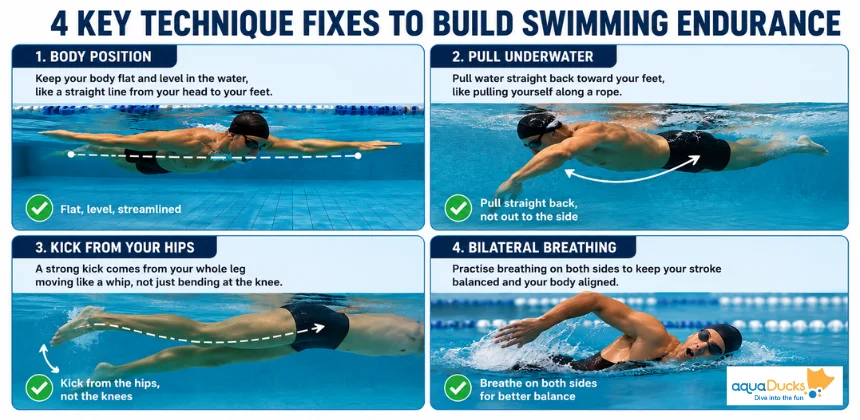
- Body position: Keep your body flat and level in the water, like a straight line from your head to your feet. If your legs or hips sink, you’re dragging extra weight through the water with every stroke.
- You pull underwater: Picture pulling water straight back toward your feet, like pulling yourself along a rope, instead of pushing it out to the side. A clean pull moves you forward with less effort.
- Kicking from your hips, not your knees: A strong kick comes from your whole leg moving like a whip, not just bending and kicking from the knee. Big knee-only kicks tire your legs out fast without adding much speed.
- Breathing on both sides: Most swimmers only breathe on one side out of habit. Practising breathing on both sides (called bilateral breathing) keeps your stroke balanced and stops one arm from working harder than the other.
For beginners, fixing body position is usually the fastest stamina win. For more advanced swimmers, the pull and kick are often what finally break a long-stuck point.
A Simple 4-Week Swimming Endurance Plan for Singapore Swimmers
Pick a plan you’ll stick with, in a pool you can get to. That matters more than how fancy it looks on paper. Most ActiveSG pools and condo pools open early, before the heat and the crowds set in, so try to swim around the same time each day if you can.
This plan works for complete beginners and confident swimmers alike. Keep an easy, steady pace throughout if you’re a beginner. If you’re more experienced, push a little harder on the laps marked “build.”
Week 1: Just Get Comfortable
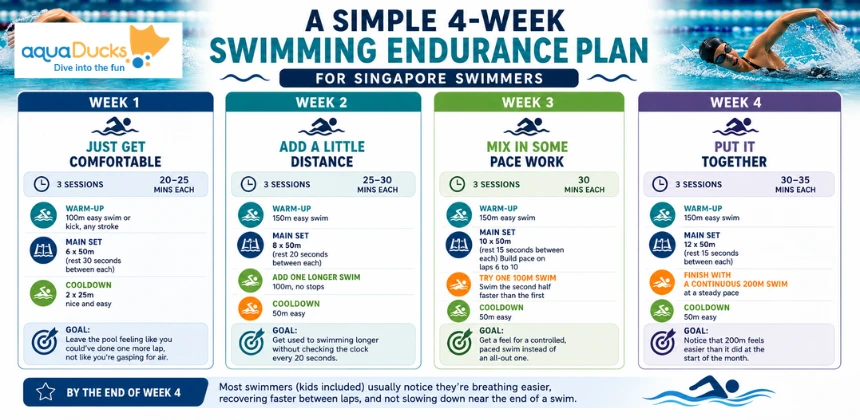
3 sessions this week, 20 to 25 minutes each
- Warm-up: 100m easy swim or kick, any stroke
- Main set: 6 x 50m, resting 30 seconds between each
- Cooldown: 2 x 25m, nice and easy
- Goal: leave the pool feeling like you could’ve done one more lap, not like you’re gasping for air
Week 2: Add a Little Distance
3 sessions, 25 to 30 minutes each
- Warm-up: 150m easy swim
- Main set: 8 x 50m, resting 20 seconds between each
- Add one longer swim: 100m, no stops
- Cooldown: 50m easy
- Goal: get used to swimming longer without checking the clock every 20 seconds
Week 3: Mix In Some Pace Work
3 sessions, 30 minutes each
- Warm-up: 150m easy swim
- Main set: 10 x 50m, resting 15 seconds between each (build pace on laps 6 to 10)
- Try one 100m swim where you swim the second half faster than the first
- Cooldown: 50m easy
- Goal: get a feel for a controlled, paced swim instead of an all-out one
Week 4: Put It Together
3 sessions, 30 to 35 minutes each
- Warm-up: 150m easy swim
- Main set: 12 x 50m, resting 15 seconds between each
- Finish with a continuous 200m swim at a steady pace
- Cooldown: 50m easy
- Goal: notice that 200m feels easier than it did at the start of the month
By the end of week 4, most swimmers (kids included) usually notice they’re breathing easier, recovering faster between laps, and not slowing down near the end of a swim.
5 Swimming Mistakes That Are Killing Your Endurance
Even swimmers who train often can run out of steam if a few habits are working against them. Here are five of the most common ones, and quick fixes for each.
- Stopping to rest at every wall: Grabbing the wall for a break after every lap, even during a set meant to build stamina, breaks your rhythm and makes each lap feel like starting over. Save your full rests for between sets, not every lap.
- Holding your breath too long: Many swimmers, especially beginners, hold their breath instead of breathing out slowly underwater. Practising a steady exhale often helps within a week or two.
- Skipping rest days: Swimming hard every day with no break leaves your muscles tired and your form sloppy. One or two rest days a week help you recover and come back stronger.
- Skipping the warm-up: Jumping straight into hard sets with cold muscles tires you out faster and raises your chance of injury. A short, easy warm-up actually saves energy for the part of the swim that matters.
- Comparing your pace to someone else’s: Every swimmer improves at their own speed. Tracking your own progress week to week matters far more than where you stand next to anyone else.
How a Coach Speeds Up Your Progress
You can build endurance on your own with the steps above, but working with the right swimming school gets you there faster and helps you dodge bad habits before they set in.
- Spot what you can’t feel: It’s hard to judge your own stroke while you’re swimming. A coach watches from the side and catches small issues, like a dragging kick or rushed breathing, before they turn into habits that are harder to undo.
- Builds a plan around you: The 4-week plan earlier in this guide is a solid starting point, but a coach adjusts the sets, rest periods, and pace to match your exact fitness level, age, and goals.
If you want that kind of structure, AquaDucks offers swim stroke & development classes or competitive swimming lessons that are built around this exact kind of stamina-building for swimmers aged 9 and up.
- Keeps you accountable: Most people lose steam in week two or three, usually because skipping a session feels easy when no one’s expecting you. A lesson on the calendar makes it that much harder to skip.
- Knows when to push and when to hold back: Pushing too hard, too soon, can stall progress or cause injury. A coach knows when you’re ready for more, and when it’s smarter to ease off.
Conclusion
Small, steady habits build swimming endurance, swimming regularly, pacing yourself, mixing in interval sets, and cleaning up your stroke. The 4-week plan in this guide gives you a place to start, and avoiding the common mistakes covered earlier keeps you from losing that progress without realising it.
Whether you’re a beginner just learning to swim one full lap in one go or an intermediate working toward longer, faster swims, the path forward looks the same. Stay consistent, keep your technique sharp, and be patient with your own pace. A coach can speed things up along the way, but even without one, sticking to the basics in this guide will get you swimming further than you could before.
If you’d like a coach in your corner, AquaDucks offers swimming lessons in Singapore for every age and skill level, with certified coaches and pools across the island. Book a trial lesson today and see how much faster things click with the right guidance behind you.
FAQs
How long does it actually take to build swimming endurance?
Most people notice a real difference within 3 to 4 weeks of consistent swimming, which is why the plan in this guide is built around that timeframe. Bigger jumps, like swimming non-stop for 500m or more, usually take a few months of regular training. The biggest factor is simply how often you show up. That consistency is really the heart of endurance swimming.
Why do I run out of breath so much faster swimming than running?
Swimming is harder on your breathing because your face is in the water, and you can only breathe at certain points in your stroke, not whenever you feel like it. Water also presses on your chest, making it a bit harder to fully expand your lungs. This is normal, and it gets easier as your breathing rhythm and technique improve.
Does swimming actually increase lung capacity?
Your lung size stays about the same. What training changes is how efficiently your lungs work: your body gets better at using the air you take in and holding your breath for longer stretches between strokes. That’s why swimmers often feel like their lung capacity has improved, even though the real shift is in efficiency, not size.
Is swimming better than running for building endurance?
Neither is automatically better; they build endurance in different ways. Running is harder on your joints but easier to start with no equipment. Swimming is gentler on your body since the water supports your weight, but it demands more from your breathing and technique. Many swimmers use running or cycling as cross-training, which this guide covers above.
What should I eat or drink before swimming to last longer in the water?
A light meal with carbs, like a banana or some toast, about an hour before swimming, gives you steady energy without weighing you down. Drinking water before you swim matters too; even though you’re surrounded by water, it’s easy to get dehydrated in a pool without realising it, especially in the hot weather.