
Every parent wonders the same thing before signing their child up for swim lessons: Can I really trust this place?
It’s a fair question. All the pools look pretty similar from the outside. Coaches all smile in their photos. But the things that count most, like how staff is trained, how safety is handled, and what happens when no one’s watching, are hard to judge just by walking in the door.
That’s why we went looking for a way to prove it. We’ve earned ISSA Two-Star Accreditation from the International Swim Schools Association. It means someone outside AquaDucks has already looked closely at the things you’d want to check yourself, like training and safety, and confirmed they’re actually there.
So keep reading, here’s exactly what that involved, and what it means for your child’s lessons at AquaDucks.
What Does ISSA Two-Star Accreditation Actually Mean?
The International Swim Schools Association, or ISSA, is a global organisation that sets standards for swim schools around the world. Their goal is simple. They want swim schools everywhere to get better at what they do, so your child can learn to swim in a safe, well-run place with coaches who really know what they’re doing.
ISSA doesn’t hand out accreditation to just anyone who asks. A school has to fill out a detailed questionnaire and provide real documents to support it, covering things like teaching standards, safety practices, and how the school treats its customers.
How the Levels Work
Accreditation comes in a few levels, and the score a school gets decides which level it reaches. Two-Star sits right in the middle. Reaching it means a school has already built strong habits around safety and teaching, and is actively working toward the next level. Think of it less as a finish line and more as proof that a school is on the right track.
Why Accreditation Matters When You’re Choosing a Swim School
Even after a visit, choosing a swim school can still feel like a guessing game. Everyone’s friendly, the pool looks clean, the coaches seem nice. None of that tells you what really happens during a lesson, or what the school would do if something went wrong.
A website can say anything. Writing “we care about safety” costs nothing, and it doesn’t prove a thing. Accreditation is different. It requires detailed documentation, an independent review, and a high enough score to pass. A school only goes through that process if it’s committed to meeting those standards, not just talking about them.
So the question changes. It’s no longer “does this place seem fine?” It’s “has this place actually been checked, and did it pass?” That’s a much simpler question to answer with confidence.
The 8 Standards Behind AquaDucks’ ISSA Two-Star Accreditation
Accreditation isn’t just one big checkmark. It’s a set of smaller standards covering different parts of how AquaDucks operates as a swim school in Singapore, from teaching and safety to day-to-day operations. Here’s what it had to prove, standard by standard, to earn it.
1. A Curriculum That Actually Builds Skill, Step by Step
Good lessons don’t jump around. They follow an order, so a child learns to float before they learn to kick, and kicks before they swim a full stroke. Coaches track how each child is doing, so nobody gets stuck repeating a skill they’ve already mastered, or pushed ahead before they’re ready. At AquaDucks, your child moves forward at their own pace, not on a fixed timetable.
2. Safety and Safeguarding, Done Properly
Staff go through background checks before they ever work with children. Class sizes are kept small enough for coaches to actually watch every child in the water. There are clear steps in place for what to do if something goes wrong, and coaches are trained to notice signs that a child might be struggling or unsafe, in the water or out of it.
3. Coaches Who Never Stop Training
A certificate earned years ago doesn’t mean much on its own. Coaches keep learning, get checked on regularly, and have someone senior watching over their teaching. That way, skills stay sharp, term after term.
4. Pool Water That Meets Government Standards
The water gets tested, and the chemicals used to keep it clean are measured and controlled, not eyeballed. Government rules set the bar here, and pools are checked regularly to make sure they’re meeting it. Your child swims in water that’s actually been confirmed safe, not assumed to be.
5. A Genuinely Safe Place to Learn
Safety isn’t only about the water. It’s the pool deck that won’t cause a slip, the changing rooms kept clean and supervised, and exits that are clear if they’re ever needed in a hurry.
6. Straightforward Terms, No Surprises
Before you sign up, you should know exactly what you’re agreeing to. That means plain terms and conditions, a clear refund policy, and rules that are shared upfront instead of buried somewhere you’d never think to look.
7. A Swim School That Gives Back
Being accredited also means being part of something bigger than one school. It’s a sign the school sees itself as part of the wider community, alongside its everyday business.
8. Doing Our Part for the Environment
Running a pool uses water and energy, and how carefully that’s managed matters. This standard checks that a school is thinking about that impact, with an eye on the years ahead.
How This Accreditation Shapes Swimming Lessons at AquaDucks
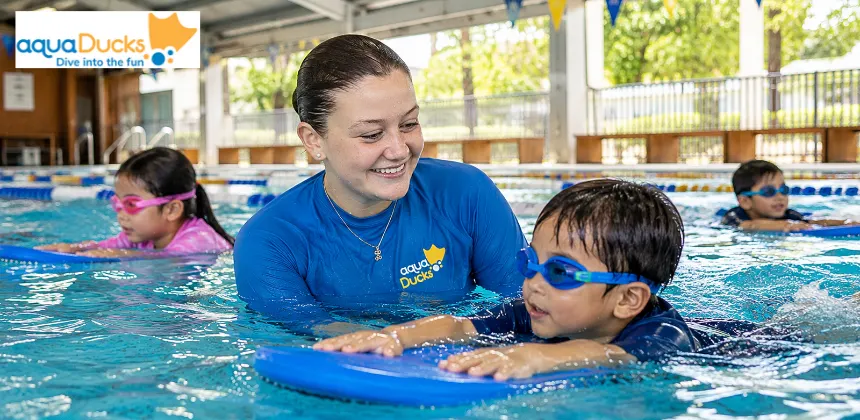
The standards behind this accreditation show up in every class. Coaches follow a clear, step-by-step curriculum, class sizes stay small enough to actually watch every child, and the water is tested and properly treated, not left to guesswork.
That same care runs through every swimming programme AquaDucks offers, starting from 4 months old.
- Parent-assisted infant and toddler classes
- Structured Learn to Swim lessons from age 5
- Competitive training for swimmers aged 8 and above
- Adult classes, with no upper age limit
- Senior aquaFit classes for ages 55 and above
- Private and semi-private lessons for closer attention
All of it runs across six locations island-wide, including Queenstown, Mountbatten, Pasir Panjang, Upper Bukit Timah, Hollandse Club, and Swiss Club. Families get the same quality teaching no matter which class or location they choose.
Conclusion
Every parent wants to feel sure, not hopeful, about where their child learns to swim. That’s what this accreditation really comes down to. ISSA looked closely at how we teach, how we handle safety, and how we run things day to day, and confirmed it all holds up.
It’s not about clean pools or friendly coaches alone, it’s about real standards behind the curriculum, the safety checks, and the training your child gets in every lesson. Standards keep evolving too, and so will we, one lesson at a time.
If you’re looking for a swimming school in Singapore you can feel good about, we’d love to show you around. Book a trial lesson at Aquaducks, walk through our pools, meet our coaches, and ask us anything you’re curious about. Some things are easier to believe once you’ve seen them for yourself.
FAQs
1. Is ISSA accreditation recognised internationally, or just in certain countries?
ISSA is a global organisation, not a local one. It works with swim schools across different countries, using the same standards no matter where a school is located. So when a swim school in Singapore earns this accreditation, it’s being judged the same way as a school anywhere else in the world, not a softer version of it.
2. What’s the difference between an accredited swim school and a certified coach?
These are two separate things, and it’s easy to mix them up. A coach’s certification is about one person, their own training and qualifications. A swim school’s accreditation looks at the whole business: how lessons are structured, how staff is supervised, how safety is handled across every class. A great coach doesn’t automatically mean a great school, and accreditation is what looks at the bigger picture.
3. Does being accredited mean my child will never have an accident?
No, and we wouldn’t want to promise that. No swim school, however careful, can guarantee zero risk around water. What accreditation does is bring that risk down a lot, by making sure the right training, supervision, and safety habits are actually in place. It’s about giving your child the safest environment possible, not an impossible guarantee.
4. How can I check a swim school’s accreditation myself, instead of just taking their word for it?
ISSA has a public directory on their own website, listing accredited schools by name. You can search it yourself in just a couple of minutes, rather than relying only on what a school tells you. That way, the confirmation comes from an outside source, not a claim the school is making about itself.
5. What age should my child start swimming lessons?
Many children start as early as a few months old, often in parent-and-child classes built around comfort and gentle water exposure. Formal lessons usually begin a bit later, once a child can follow simple instructions. There’s no single right age; it depends on your child’s comfort in the water and how ready they are.