
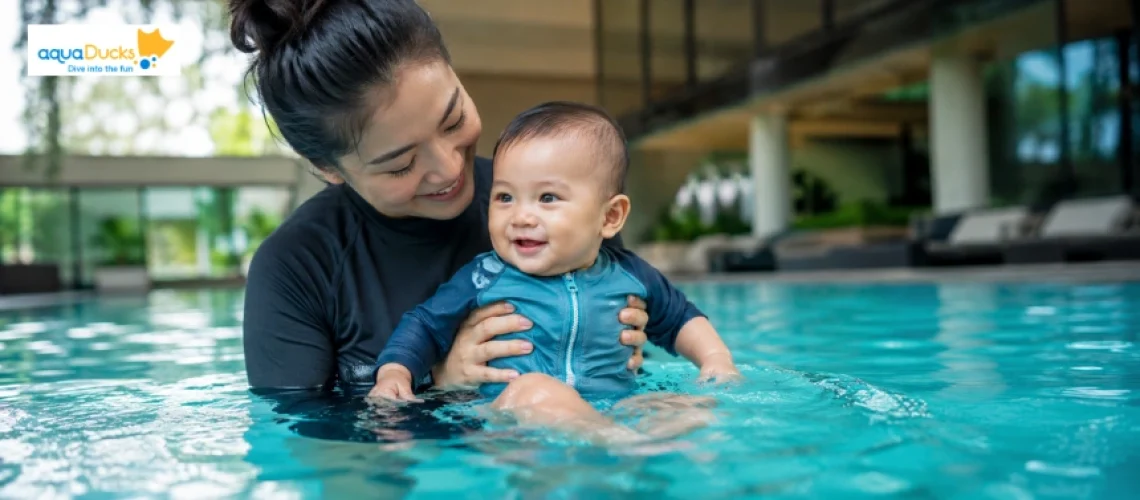
Your baby’s first splash in the pool should feel exciting, not stressful. But right before that first lesson, most parents aren’t sure about one thing: what do babies wear swimming?
A regular diaper won’t work in the water, and not every swimsuit at the store will do the job either. Singapore’s sun is strong too, and most pools simply won’t let babies in without a swim diaper.
You only need a few simple things to get your baby ready, nothing fancy, nothing you can’t find in one quick trip. Just the basics, explained simply in this guide, so you can pack your bag and head to your baby’s first class feeling confident instead of confused.
Baby Swim Essentials: What to Pack for Your Baby’s Swim Class
Let’s go through each item, so you know exactly what to grab and why it matters.
1. Swim Diaper
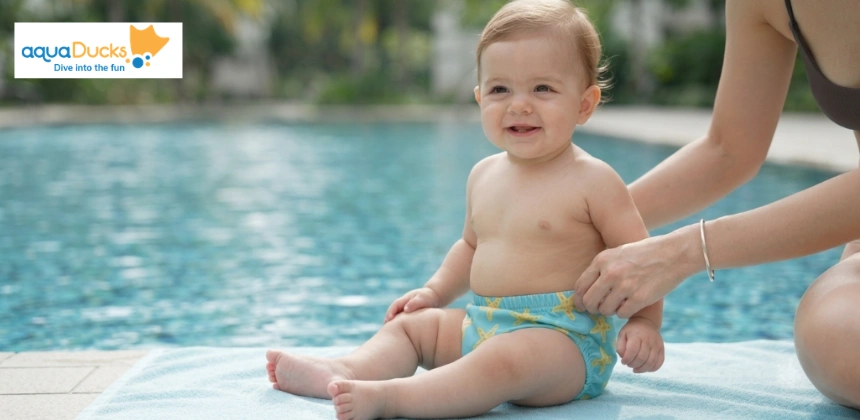
Swim diapers are designed to contain solid waste. Unlike regular diapers, they don’t absorb pool water or hold urine, so they stay light instead of getting heavy. Look for a snug fit around the legs, sizing can run different from regular diapers, so check the size chart first. A loose fit can let things slip out. You can go reusable or disposable, pick whichever fits your routine best.
2. Swimsuit or Rash Guard
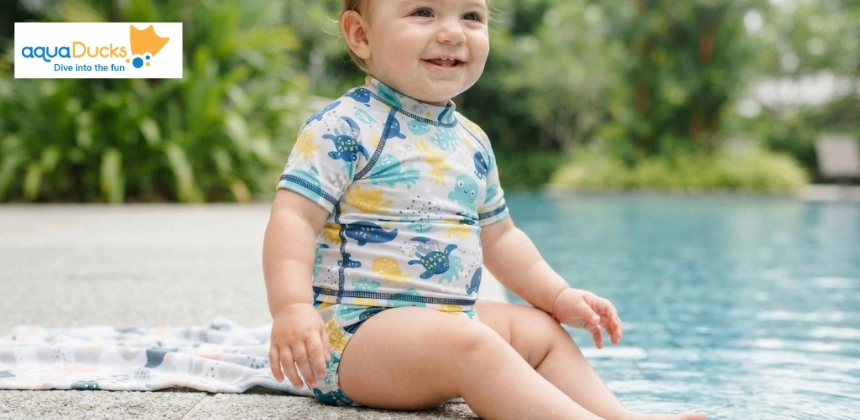
This goes over the swim diaper, not instead of it. A snug-fitting swimsuit or rash guard keeps your baby comfortable and covered. Go for something quick-drying and stretchy, since your baby will probably be sweaty before they even get in the water.
3. Swim Hat
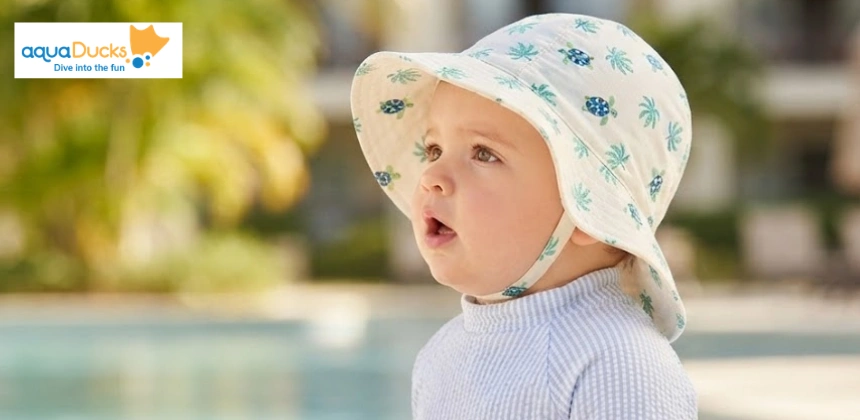
For outdoor classes, a lightweight swim hat can help protect your baby’s head and face from the sun while you’re out of the water. Pick something soft and breathable so it doesn’t feel tight on your baby’s head.
4. Sunscreen
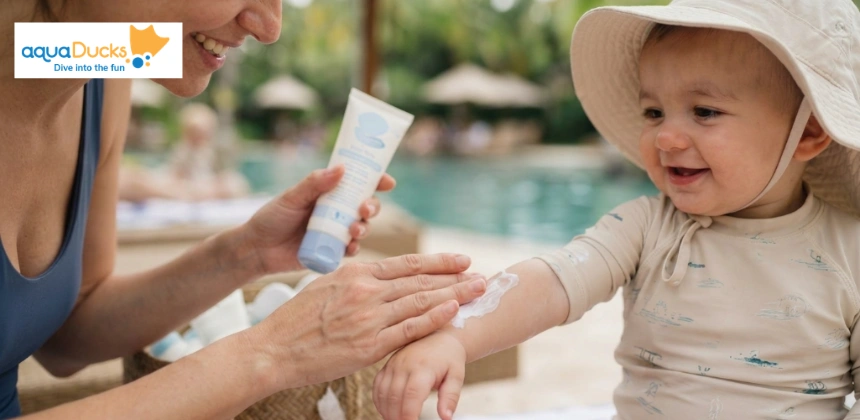
If your baby is under 6 months, doctors recommend keeping them out of direct sun altogether rather than using sunscreen. Shade, a hat, and light clothing are safer at this age. For babies over 6 months, use a broad-spectrum, water-resistant sunscreen made for babies, ideally a mineral formula with zinc oxide or titanium dioxide, gentler on sensitive skin. Apply it about 15-20 minutes before heading outdoors.
5. Goggles or Flotation Devices
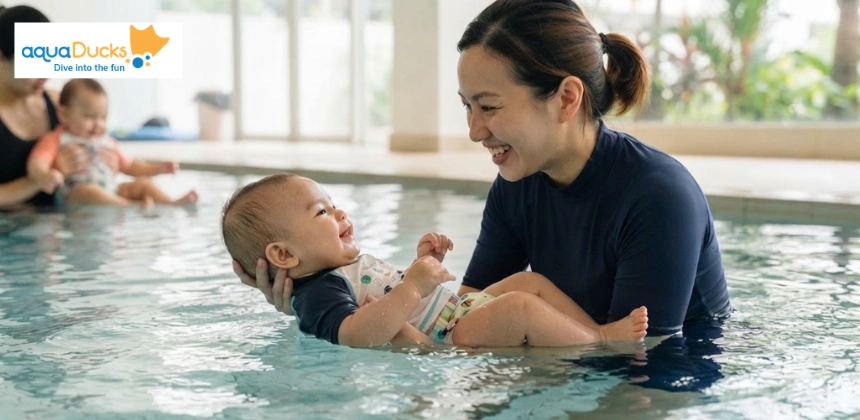
Most babies don’t need goggles or flotation devices during lessons. Your instructor will let you know if any specific equipment is recommended.
If you haven’t enrolled yet, aquaDucks offers Infant Swimming lessons for babies as young as 4-5 months, focused on gentle water exploration, and a Babies & Toddlers programme for little ones aged 6-35 months, where parents join in for interactive, parent-assisted lessons.
6. Towel and Change of Clothes
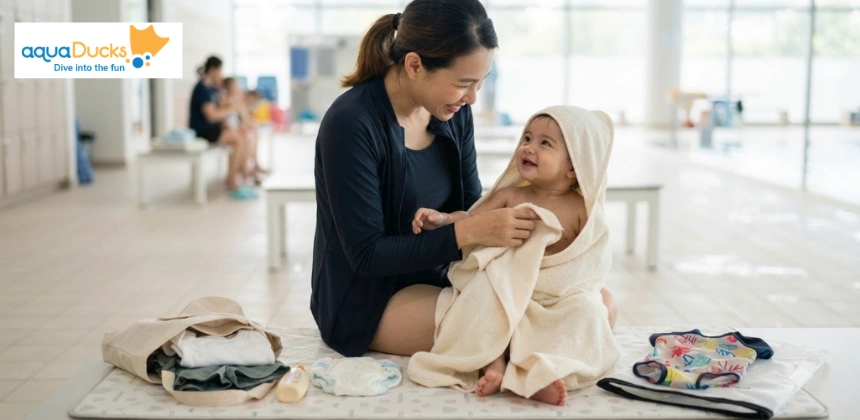
Simple, but easy to forget. Bring one towel to dry your baby off and a full change of clothes for afterwards. Pool chemicals and wet swimwear aren’t ideal for the ride home.
Baby Swimwear Mistakes Most Parents Make
A few small slip-ups can make swim class harder than it needs to be. Here’s what to watch out for.
- Sizing by age instead of weight. Most swimwear brands go by weight, not age, so a baby who’s bigger or smaller than average can end up in the wrong size.
- Picking a loose fit to “leave room to grow.” Swimwear only works well when it’s snug. A loose fit tends to shift or gap once your baby’s actually moving in the water.
- Not rinsing swimwear after class. Leftover chlorine in the fabric can irritate sensitive skin the next time it’s worn.
- Bringing just one swim diaper. Mid-class changes happen more often than you’d think, so a spare saves you from cutting the lesson short.
- Not checking the fabric quality. Cheaper, non-chlorine-resistant material tends to wear out and lose its shape after just a few sessions.
Conclusion
Getting your baby ready for their first swim doesn’t need to be complicated. A snug swim diaper, comfy swimwear, and a bit of sun protection are really all it takes, no complicated gear, no guesswork required.
Once that’s sorted, you’ve already done the hard part. The rest is just showing up, letting your baby splash around, and watching them enjoy the water while you get more comfortable too. Every parent feels a little unsure walking in for the first class, and that’s completely normal. It gets easier from here.
Whenever you’re ready, aquaDucks offers kids swimming lessons in Singapore to help your baby feel confident in the water from day one. Book a trial class today.
FAQs
1. What age can babies start swimming lessons?
Most swim schools in Singapore, including aquaDucks, welcome babies from around 4-5 months old. At this age, classes usually focus on getting comfortable in the water rather than actual swimming. Think gentle floating and splashing with a parent right there.
2. Is chlorine safe for a baby’s skin?
Yes, as long as the pool keeps its chlorine at the right level, which most proper swim schools do. Rinsing your baby off with fresh water after class also helps prevent any dryness or irritation.
3. How long can a baby wear a swim diaper before it needs changing?
It’s best to check every 30-45 minutes, even if it looks clean. Swim diapers don’t swell up the way regular diapers do, so it’s easy to miss when a change is actually needed.
4. Do babies need a wetsuit for swimming lessons?
Not usually, especially for indoor, heated pools like the ones most Singapore swim schools use. A wetsuit is more common for cooler, outdoor water, but for a typical baby swim class, a swimsuit or rash guard is enough.
5. Can babies swim in outdoor pools or the sea, or only pools made for lessons?
Babies can go in outdoor water too, but pools built for lessons are usually easier on them since the temperature stays steady. If you do take your baby to an outdoor pool or the sea, keep an eye on water temperature and sun exposure a little more closely.