
Your child comes home from Primary 3 SwimSafer 2.0 lessons with a stage number, and you are not sure what it means. Another parent at the condo pool says her son is “doing Silver”, the school letter mentions a theory quiz, and nobody explains why a 9-year-old who swims happily in the shallow end failed Stage 2. The names Bronze, Silver and Gold sound like medals, but they are not ranks in a race. They are tests of very specific skills.
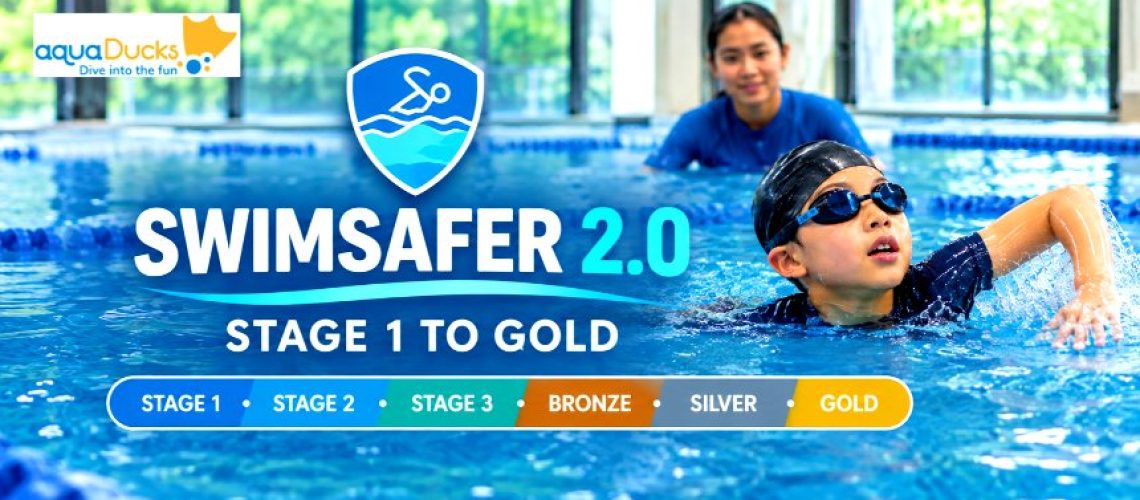
SwimSafer™ 2.0 is Singapore’s national water safety and swimming programme, run by Sport Singapore (SportSG). It has six stages: Stage 1, Stage 2, Stage 3, then Bronze (Stage 4), Silver (Stage 5) and Gold (Stage 6). Each stage tests a fixed list of skills, from a 10m swim on the front at Stage 1 to timed 100m swims in three strokes at Gold. Below is exactly what each stage asks for, how the test and e-certificate work, and how to tell which stage your child is ready for.
What SwimSafer 2.0 Is and Who Runs It
SwimSafer started in July 2010 as an initiative of the National Water Safety Council together with what was then the Singapore Sports Council. It replaced the older Learn-to-Swim programme and the National Survival Swimming Award. After a review in 2016 and 2017, the refreshed SwimSafer 2.0 was launched in 2018, and all MOE primary schools moved to it that year.
Today SportSG owns the programme and Singapore Aquatics runs the assessment system, called CAMS, along with the central assessment centres at ActiveSG pools. The programme’s main aim is drowning prevention. That is the part many parents miss. SwimSafer 2.0 is not only about swimming laps. Every stage covers seven areas: entries and exits, sculling and body orientation, underwater skills, strokes, survival skills, rescue skills, and water safety knowledge.
So a child who swims a strong 25m freestyle can still fail a stage if they cannot float on their back for 10 seconds, recover an object from chest-deep water, or put on a life jacket in the water. The test is built around what keeps a person alive if they fall into a canal, a reservoir or the deep end of a hotel pool, not around speed.
The name SwimSafer is a trademark of SportSG. SportSG and Singapore Aquatics are the only official SwimSafer websites. Swim schools and coaches can teach the skills and prepare children for the stages, but the assessment itself is booked through CAMS and carried out by accredited assessors.
The Six SwimSafer 2.0 Stages and What Each One Tests
Before the detail, here is the overall ladder. Distances and times come from the SwimSafer 2.0 instructors’ block plan published on ActiveSG Circle (updated 1 July 2025).
| Stage | Main swimming goal | Key survival or rescue skill | Deepest water used |
|---|---|---|---|
|
Stage 1 |
10m on front, 5m on back | Grab a float and kick to the edge | Chest-deep |
|
Stage 2 |
25m on front, 15m on back | Jump in with a PFD, swim 25m |
At least 1.2m |
|
Stage 3 |
50m continuous | Put on a PFD in the water, swim 50m with it |
At least 1.4m |
|
Bronze (Stage 4) |
100m in four strokes | 3-minute survival swim, throw rescue at 2m |
At least 1.8m |
|
Silver (Stage 5) |
200m of timed and untimed strokes | HELP for 30 seconds, throw a PFD 3m |
At least 1.8m |
| Gold (Stage 6) | 400m with timed 100m swims | Make a float from long pants, HELP for 1 minute |
At least 1.8m |
PFD means personal flotation device, such as a life jacket. HELP stands for Heat Escape Lessening Posture, a curled floating position that slows heat loss when someone is stuck in the water waiting for rescue.
Each stage is designed around roughly 12 hours of lesson time, according to the Ministry of Culture, Community and Youth. In practice, most children need more than 12 hours for the jump from Stage 3 to Bronze and again from Bronze to Silver, because those stages bring in deep water and timed swims.
SwimSafer Stage 1: Water Confidence
Stage 1 is for children who are new to water or still nervous in it. The goal is independence: getting in and out safely, moving a short distance, and not panicking with the face in the water.
What the child is tested on:
- Entry and exit: slide in from the edge, climb out by the ladder and from the pool side.
- Floating: a front float (mushroom or jellyfish float) for 5 seconds, then stand up; a back float for 5 seconds, then stand up.
- Underwater: submerge in waist-deep water with eyes open and blow bubbles; pick up an object from chest-deep water.
- Movement: 10m on the front and 5m on the back, with any arm and leg action.
- Survival: signal for help, grab a flotation aid and float for 10 seconds, then move to the edge and climb out. There is also a sequence where the child fits a PFD, jumps in, floats for 30 seconds and climbs out.
The skill that most often holds children back at Stage 1 is the back float. A child who is fine on their tummy may stiffen, lift their head and sink the moment they lie back. This is normal and usually comes down to trust, not strength. Short, calm practice where the child’s ears go under while an adult supports the back of the head helps far more than repeating the full test. A child who still clings to the wall needs a few small steps before Stage 1 makes sense, and these tips on helping your child overcome a fear of water cover them.
SwimSafer Stage 2: The 25m Milestone
Stage 2 is where swimming starts to look like swimming. The child moves from the shallow end into water at least 1.2m deep and is expected to keep going without touching the floor.
What Stage 2 tests:
- Entry: step in from the edge, unassisted.
- Floating and rolling: front float for 10 seconds, swim 5m on the front and roll onto the back; back float for 10 seconds, then swim 5m on the back.
- Sculling: scull, float or tread water for 30 seconds.
- Underwater: in water at least 1.2m deep, swim through hoops on the pool bottom for 2m.
- Strokes: 25m on the front and 15m on the back.
- Survival: swim 15m with any survival stroke and climb out; fit a PFD, jump into water at least 1.4m deep, swim 25m wearing it and climb out.
The 30-second scull or tread is the item to watch. Many children can swim 25m by sprinting with their head down, but when asked to stay in one place in deep water they panic and grab the lane rope. Thirty seconds sounds short. For a 7-year-old who has never been out of their depth, it feels long. Practise it in the deep end of an ActiveSG pool or a condo pool with a parent close by, building from 10 seconds up.
SwimSafer Stage 3: 50m and Life Jacket Skills
Stage 3 doubles the swimming distance and adds jumping entries and real water survival practice with a life jacket. Pass rates show how big this step is: MOE’s 2019 data showed 83% of primary school participants met at least Stage 1, 55% met Stage 2 and 39% met Stage 3.
What Stage 3 tests:
- Entry: stride or straddle jump, and a compact jump.
- Sculling: scull, float or tread for 50 seconds; scull head-first on the back for 5m.
- Underwater: in water at least 1.4m deep, a feet-first surface dive, then swim through hoops on the bottom for 2m.
- Strokes: 50m continuously, for example 25m front crawl and 25m backstroke, or 25m breaststroke and 25m survival backstroke.
- Survival: swim 25m using survival backstroke or survival breaststroke (face clear of the water) to a PFD, put it on while in the water, swim 50m with it and climb out.
Putting on a life jacket while floating is harder than it looks. The child has to stay calm, keep their face up and work the straps with wet hands, all without anything to stand on. Children who struggle here usually need more time sculling with their hands free, so that staying afloat no longer takes all their attention.
SwimSafer Bronze (Stage 4): 100m and the First Rescue
Bronze is where SwimSafer 2.0 shifts from “can swim” to “can swim properly and help someone else”. The water is now at least 1.8m deep for the underwater skills, and the child needs four different strokes.
What SwimSafer Bronze tests:
- Entry: a crouching dive, a compact jump into water at least 1.4m deep, and a forward somersault in the water.
- Sculling: scull, float or tread for 2 minutes.
- Underwater: in water at least 1.8m deep, a feet-first surface dive, clearing the ears if needed, then swim through hoops for 3m.
- Strokes: 100m continuously: 25m front crawl, 25m backstroke, 25m breaststroke and 25m survival backstroke.
- Survival: a 3-minute slow swim using survival backstroke, sidestroke and survival breaststroke, changing stroke every 15m; then wave and call for help, swim to a thrown flotation aid and kick to the edge.
- Rescue: throw a flotation aid to a partner 2m away and tell them to kick to the edge.
Two things trip children up at Bronze. The first is breaststroke legs. A scissor kick (one leg doing breaststroke, the other doing front crawl) is common and will not pass. The second is the 2-minute tread. Children who tread by thrashing tire after about 60 seconds. They need a slow, efficient egg-beater or breaststroke kick and calm sculling hands, and both come from steady weekly practice rather than a few extra sessions the week before the test.
SwimSafer Silver (Stage 5): Timed Strokes and Diving
Silver is the first stage with time limits, and it adds head-first surface dives and the HELP posture. For many children this is the hardest step in the whole programme, because the times expose weak technique.
What SwimSafer Silver tests:
- Entry: a standing dive, a stride or straddle jump, and a backward somersault in the water.
- Underwater: in water at least 1.8m deep, a head-first surface dive (tuck or pike), clearing the ears if needed, then swim through hoops for 5m.
- Timed strokes: 50m front crawl within 1 minute 30 seconds, 50m breaststroke within 1 minute 50 seconds, and 50m backstroke within 1 minute 40 seconds.
- Other strokes: 25m survival backstroke, 25m sidestroke and 10m dolphin kick on the front.
- Survival (in swimwear, long pants and a T-shirt): wave and call for help, retrieve a thrown PFD and put it on while treading water, hold the HELP position for 30 seconds, swim 25m with the PFD and climb out. There is also a 45m fast front crawl, as if swimming away from a sinking boat.
- Rescue: throw a PFD to a partner 3m away and tell them to kick to the edge.
The times are not fast for a club swimmer, but they are tight for a child who still lifts their head to breathe on every stroke. A 50m front crawl in 1:30 means holding a steady pace without stopping. Swimming in clothes also surprises children. Wet long pants are heavy and drag the legs down. Practising at least once in an old T-shirt and track pants, at a pool that allows it, makes the real test far less of a shock.
SwimSafer Gold (Stage 6): 400m and Self-Rescue
SwimSafer Gold is the top of the programme. It asks for 400m of swimming across six strokes, three of them timed, plus a full self-rescue sequence in clothes.
What SwimSafer Gold tests:
- Timed strokes: 100m front crawl within 3 minutes, 100m breaststroke within 4 minutes, and 100m backstroke within 3 minutes 20 seconds.
- Other strokes: 50m survival backstroke, 50m sidestroke and 15m butterfly.
- Underwater: a head-first surface dive in water at least 1.8m deep, then swim through hoops on the bottom for 5m.
- Survival (in swimwear, long pants and a T-shirt): a compact jump into deep water; take off the long pants while treading water and turn them into a float within 5 minutes; hold the HELP position with the home-made float for 1 minute; swim 25m with the float and climb out. The sequence also includes a fast 45m front crawl followed by a slow 50m swim.
- Rescue: none at Gold. The focus is self-rescue.
The clothing float is the item children talk about afterwards. The child ties the ends of the trouser legs, swings the pants overhead to trap air, and holds the waistband underwater so the legs puff up like a float. It takes practice and calm breathing, which is why the 5-minute limit matters. A child who panics will tire before the pants are ready.
Gold does not mean a child is safe in any water. Open water at East Coast or Sentosa has currents, waves and murky visibility that a pool test cannot copy. It does mean the child has the strokes, stamina and survival habits to give themselves a real chance.
How the SwimSafer 2.0 Test Works
Every stage has two parts, and the child must pass both to get the certificate:
- A practical assessment in the pool. The child must be assessed as 100% competent. Every item on the stage list has to be done correctly. A strong swim does not make up for a failed back float.
- An online theory quiz. The pass mark is 90%. The quiz covers five topics: personal safety and survival, environmental awareness, health awareness, emergency situations, and rescues. It can be retaken as often as needed, but it must be completed within 7 days after the practical assessment.
Some practical details parents ask about:
- Who assesses: accredited SwimSafer assessors appointed by Singapore Aquatics. Assessors do not test their own students, so your child’s coach will not be the person marking them.
- Where: for private assessments, at central assessment centres in ActiveSG pools or at approved venues. In November 2026 the North centre moved from Yishun to Teck Ghee, and the West centre stays at Jurong West until March 2027.
- Group sizes: up to 20 children for Stage 1, 15 for Stages 2 and 3, and 10 for Bronze, Silver and Gold.
- Re-attempts: the assessor may allow up to three re-attempts of an item on the day.
- Fee: $50 per participant for a private assessment, covering the practical test and the theory quiz. School assessments are fully funded by MOE.
- Results: not given on the day. They appear on the CAMS platform within 48 hours. Appeals must be made within 72 hours, with a $50 deposit.
- Booking: registration and payment have to be completed 3 weeks before the assessment date, normally through your child’s SwimSafer-certified coach.
The full rules, venues and fees are set out on the official SwimSafer 2.0 page on ActiveSG Circle, which is the place to check for any recent changes.
SwimSafer in Singapore Primary Schools
Swimming is a key learning area in the MOE PE syllabus, and every primary school uses SwimSafer 2.0 to teach it. Schools typically enrol the whole Primary 3 cohort, and the programme is fully funded by MOE and run during curriculum time, as MOE explained in a 2021 parliamentary reply on the SwimSafer 2.0 programme.
So is SwimSafer compulsory? Strictly, MOE does not use that word, and there is no rule that a child must pass a stage to move up a level. But in practice almost every P3 child takes part, because it is part of PE lessons. Schools commonly run it as a block of around 8 lessons of 1.5 hours each, with the practical test in the last session. Children who already hold a stage are usually placed in the next one. Children who swim but have no certificate usually start at Stage 1. Those who do not pass Stage 1 can join a fully funded remediation programme and be tested again.
Eight school lessons are enough for many children to pass Stage 1, and some reach Stage 2. They are rarely enough to reach Stage 3 or Bronze from scratch, which is why many families continue with lessons outside school.
Getting the SwimSafer E-Certificate
There are no paper certificates for SwimSafer 2.0. Once a child passes both the practical test and the theory quiz, an e-certificate is issued. Where you find it depends on when and how the test was taken:
- Private assessments from July 2025: the certificate is on the CAMS platform run by Singapore Aquatics. Log in to the account used to register your child and download it there. Children below 15 are being moved to their parent or guardian’s Singpass login, and SportSG has asked families to make sure the account shows the child’s correct full name, NRIC or FIN and date of birth.
- Earlier certificates and many school-run assessments: parents receive an email titled “Your SwimSafer Certificate is ready” from SportSG through FileSG. Go to file.gov.sg/retrieve, enter the transaction ID from the email, choose to retrieve without Singpass if your child is under 15, confirm the child’s NRIC or FIN and date of birth, and key in the one-time password sent to you.
- The MyActiveSG app and portal stopped being used for SwimSafer certificate downloads from 15 August 2024, so older instructions that point there are out of date.
Only certificates issued by SportSG are recognised. A genuine one carries the ActiveSG branding. If a school asks for proof of a stage, this e-certificate is what they mean.
Which SwimSafer Stage Should Your Child Start At?
SportSG’s assessment handbook recommends a minimum age of 6 for SwimSafer. Younger children can learn the same skills, but they often find the deep-water items and the theory quiz hard to manage.
Rather than going by age, look at what your child can already do:
- Can’t yet float on their back or put their face in without fuss: start with Stage 1.
- Swims 10m comfortably but not yet out of their depth: aim for Stage 2.
- Swims 25m and can tread for 30 seconds in deep water: try Stage 3.
- Swims 50m in two strokes and has a proper breaststroke kick: work towards Bronze.
- Swims 100m in four strokes without stopping: start building speed for Silver.
- Already passes Silver times with room to spare: Gold is within reach.
Children do not have to start at Stage 1 if their skills are already there. They do have to pass the stage they sit. A child pushed into a stage too early tends to fail one or two items and lose confidence, which costs more time than going one stage at a time.
How Swim Lessons Prepare Children for SwimSafer Stages
SwimSafer sets the standard. It does not dictate how a child learns. School lessons run at about 1 coach to 10 children, which is fine for Stage 1 basics but leaves little time to fix a scissor kick or a poor breathing pattern. A regular programme outside school helps because the same skills get practised every week, not only in one 8-lesson block in Primary 3.
From a coach’s side, getting a child ready for the stages comes down to three things:
- Fixing technique early. A bad breaststroke kick learned at Stage 2 has to be unlearned before Bronze. It is faster to get it right the first time.
- Deep-water time. Many Singapore children learn in shallow condo pools and rarely swim out of their depth. Every stage from Stage 2 up needs calm deep-water skills.
- Survival practice, not only laps. Floating, sculling, treading and swimming in clothes all need regular practice. Children who only swim lengths often fail on these items.
At AquaDucks, children aged 5 and above work on exactly these skills week by week, from floating and treading to survival strokes, and students in Learn to Swim Stages 1 to 4 can choose to sit the SwimSafer test when they are ready. The test is optional and is still marked by an independent SwimSafer assessor, but a child who has practised every item in class walks in knowing what to expect. To see which class suits your child’s age and current level, have a look at AquaDucks’ swimming programmes.
SwimSafer 2.0 gives every child in Singapore the same clear ladder, from a 10m swim at Stage 1 to the timed 400m and clothing float at Gold. Knowing exactly what each stage tests lets you see where your child is now, what to practise next, and why a strong swimmer can still miss a stage on one survival skill.
SwimSafer 2.0 FAQs
Can adults take SwimSafer 2.0?
Yes. SwimSafer 2.0 is open to people of all ages, not only primary school children. An adult who never learned to swim can start at Stage 1 and sit the same practical test and theory quiz. The stages and pass standards are the same as for children.
Is SwimSafer compulsory in primary school?
Swimming is part of the MOE PE syllabus and schools typically enrol the whole Primary 3 cohort in SwimSafer 2.0, fully funded by MOE. Children take part as part of PE, but passing a stage is not a requirement for moving up to the next school level.
How long does each SwimSafer stage take?
Each stage is designed around about 12 hours of lessons. Children who are confident in water may pass sooner, while the jumps to Bronze and Silver often take longer because of deep-water skills and timed swims.
How much does the SwimSafer test cost?
A private assessment costs $50 per participant, which covers the practical test and the online theory quiz. Lesson fees are separate and set by each swim school. School assessments are paid for by MOE.
What happens if my child fails a SwimSafer stage?
Results come out on the CAMS platform within 48 hours. If your child does not pass, they can keep practising and book another assessment. You can also appeal within 72 hours with a $50 deposit. At school, children who fail Stage 1 can join a funded remediation programme and be tested again.
How do I download the SwimSafer certificate?
For private assessments from July 2025, download it from the CAMS platform. For earlier and many school assessments, use the transaction ID in the “Your SwimSafer Certificate is ready” email at file.gov.sg/retrieve. The MyActiveSG app is no longer used for certificates.