
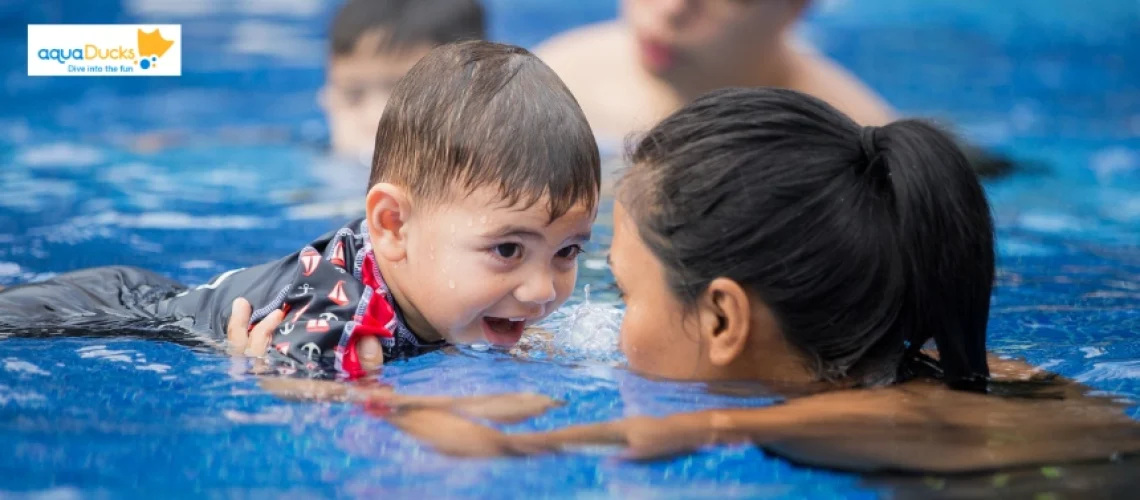
A child can slip underwater without a splash, without a cry, and without anyone noticing for several seconds. That is the uncomfortable truth behind most drowning incidents involving young children. It rarely looks dramatic. There is no thrashing, no shouting, just a quiet disappearance beneath the surface that catches even attentive parents off guard.
This is why water safety for kids needs to be treated as a separate skill from swimming itself. A child who has completed swim lessons can still get into trouble in the wrong conditions, and a strong swimmer at the pool is not automatically safe at the beach or in a lake. Parents in Singapore, where pools, water parks, and coastal outings are part of everyday life, need a working understanding of the risks and the habits that reduce them.
This guide covers what water safety actually means, why young children face the highest risk, the rules that matter most across different settings, age-specific guidance, what to do if something goes wrong, and where swim lessons fit into the picture.
What Is Water Safety for Kids?
Water safety refers to the habits, awareness, and precautions that prevent drowning and water-related injury. It covers everything from how closely a child is supervised to whether a pool gate locks properly, and it applies just as much to a toddler splashing in a garden paddling pool as it does to a teenager at the beach.
It helps to separate water safety from swimming ability early on. Swimming is a physical skill, learned through practice and repetition. Water safety is a set of judgement calls and behaviours, some of which belong to the child and most to the adult supervising them. A five-year-old might swim confidently across a pool yet have no idea how to react if a current pulls them off balance, or why jumping into unfamiliar water can be dangerous.
Every child, regardless of swimming level, benefits from water safety education. It shapes how they behave around drains, how they respond if a friend gets into difficulty, and whether they understand that rules at the pool exist for a reason rather than simply being restrictions on their fun.
Why Water Safety Matters for Children
Drowning Can Happen Silently and Within Seconds
Unlike what films tend to show, drowning is often quiet. A struggling child usually cannot call out, because the body prioritises breathing over shouting. Arms may push down on the water instead of waving for help. The entire event can unfold in under a minute, leaving almost no margin for a delayed reaction.
Most Accidents Occur Even With an Adult Nearby
A parent standing a few metres away, glancing at a phone or chatting with another guardian, can miss the moment a child goes under. Proximity alone does not guarantee protection. What matters is whether attention is actually on the water at that moment.
Singapore Data Shows Pre-Schoolers Are Most at Risk
Research from the KKH Child Injury Surveillance Report found that between 2012 and 2023, 361 children in Singapore were treated for drowning, and 86 per cent of them were seven years old or younger. Drowning was the leading cause of child injury deaths in this period, ahead of falls and road traffic injuries. Swimming pools accounted for 83 per cent of these drownings, reflecting how common residential and condominium pools are among Singapore households.
Swimming Ability Reduces Risk but Does Not Remove It
Lessons build confidence, technique, and breath control, all of which help in an emergency. They do not, however, make a child immune to fatigue, panic, cold shock, or strong currents. A capable swimmer in a calm pool can still struggle in open water with waves or undertow. Skill and safety work together, not as substitutes for one another.
Essential Water Safety Rules Every Parent Should Know
- Provide active, undistracted supervision. Watching a child near water means actually watching, not glancing over occasionally between conversations or messages. For toddlers and non-swimmers, this should mean staying within arm’s reach at all times.
- Appoint a water watcher in group settings. At birthday parties or family gatherings, it is easy to assume someone else is keeping an eye on the pool. Assign one adult specifically to that job, whether a parent, grandparent, or a domestic helper trained through domestic helper swimming lessons to supervise confidently around water, and rotate if the group is supervising for an extended period.
- Teach children to ask permission before entering water. This simple habit gives parents a chance to check the environment and confirm that supervision is in place before anything begins.
- Choose properly fitted, certified life jackets over inflatable arm floats or toys. Certified flotation devices are designed to keep a child’s head above water even if they are unconscious. Inflatable rings and sleeves can slip off or deflate, and they give a false sense of security to both child and parent.
- Discourage running near pool edges. Wet tiles are slippery, and falls near water can lead to head injuries in addition to drowning risk.
- Practise safe entry and exit at the pool. Sliding in feet first from the edge is safer than jumping blindly, particularly in unfamiliar pools.
- Check the depth before allowing any jumping. Shallow ends, sloped floors, and varying depths across a single pool catch children out often, especially in unfamiliar venues.
- Stay aware of drains and pool equipment. Strong suction from poorly maintained drains has caused entrapment injuries in the past. Children should be taught to avoid sitting or playing near them.
- Learn basic CPR. A parent trained in infant and child CPR can make a critical difference in the minutes before emergency help arrives. Courses are available through the Singapore Red Cross and St John Singapore.
Water Safety Tips for Different Environments
Pool Safety for Kids
Fenced pools with self-latching gates reduce unsupervised access significantly. Condominium and public pools should be treated with the same caution as any other pool, since lifeguard presence supports supervision but does not replace it.
Beach and Open Water Safety
Currents, waves, and unpredictable changes in depth make open water riskier than a controlled pool environment. Children should swim only where flags or lifeguards indicate it is safe, and the buddy system should apply even to confident swimmers. Rip currents in particular can pull a swimmer away from shore quickly, and the safest response is to swim parallel to the beach rather than fighting directly against the pull.
Water Park Safety
Slides and wave pools move fast, and height or age restrictions exist for good reason. Parents should check depth markers at the base of each attraction and keep younger children within direct reach at all times.
Hidden Water Hazards at Home
Bathtubs, buckets, inflatable paddling pools, and even ornamental fish ponds pose a genuine risk to toddlers, who can drown in a few inches of standing water. These hazards are frequently overlooked because they seem too small to be dangerous, yet a young child’s centre of gravity and limited strength make them just as vulnerable in a bucket as in a swimming pool.
Water Safety Rules by Age Group
Infants and Toddlers (0 to 3 Years)
Constant, hands-on supervision is non-negotiable at this stage. Babies and toddlers have no concept of danger and cannot self-rescue, so touch supervision, meaning an adult close enough to physically reach the child instantly, should apply in any setting involving water. Early water familiarisation through babies and toddlers swimming lessons can also help young children become more comfortable around water while developing basic safety habits from an early age.
Preschoolers (3 to 6 Years)
Children in this age group are curious, mobile, and often overconfident in the water. This is the age at which structured water familiarisation and early swim lessons help build both skill and caution, alongside firm household rules about never entering water alone.
School-Age Children (6 to 12 Years)
By this stage, many children swim independently, but judgement still lags behind physical ability. Reinforcing rules around diving, checking depth, and never swimming without an adult aware of their location remains important even for confident swimmers.
What to Do During a Water Emergency
If Your Child Falls Into Water
Remove the child from the water immediately. Call for emergency help by dialling 995 for SCDF ambulance services. If the child is not breathing normally, begin CPR straight away if trained to do so, and continue until help arrives. Even if the child appears to recover quickly, seek medical evaluation afterwards, since complications from water inhalation can develop hours later.
If Your Child Sees Someone Else in Trouble
Children should be taught never to jump in after a struggling friend, since this often results in two people in danger instead of one. The correct response is to shout for an adult immediately and, if a flotation aid or pool rescue hook is nearby, to throw it towards the person in difficulty rather than approaching directly.
Building Water Confidence Through Swim Lessons
Structured lessons teach far more than stroke technique. Instructors focus on breath control, calm movement in water, and how a child reacts under pressure, all of which reduce panic in a genuine emergency. Listening and following instructions matter just as much as physical ability once a child is in open water or a crowded pool, and lessons reinforce that habit early.
AquaDucks offers age-appropriate Swimming Programmes that help children become more comfortable and confident in the water. Lessons focus on developing essential skills such as floating, breathing control, and safe water habits while allowing children to progress at a pace that suits their ability. For younger children, a preschool swimming programme introduces them to the water in a supportive environment, helping them build confidence and learn basic safety skills before moving on to more advanced swimming techniques.
Conclusion
Keeping a child safe around water rarely comes down to one single rule. It is supervision that never wavers, environment-specific caution, and skills built through practice over time, all working together instead of standing in for one another. A locked pool gate still needs a watching adult, and a child who swims well still needs boundaries about where and when.
Lessons build the calm and capability a child draws on when something unexpected happens, but they support supervision without replacing it. Parents who keep these layers in place and revisit them as their child grows give their children the best chance of enjoying water safely for years to come.
FAQs
How can I teach my child to be confident but not careless around water?
Water confidence should always be developed alongside respect for safety rules. Parents can help by allowing children to practise skills in supervised environments, teaching them to recognise their limits, and reinforcing habits such as asking permission before entering water.
How do I know if my child is ready for independent swimming?
A child may be ready for more independence when they can follow safety instructions, demonstrate consistent swimming skills, stay calm in water, and understand their own limits. Readiness depends on both ability and maturity, not just age.
What is the buddy system, and why does it matter for children?
The buddy system pairs a child with another swimmer, so neither one is ever in the water completely alone. It works because a buddy can notice trouble faster than a distant adult and call for help immediately. Even confident swimmers benefit from this, since fatigue or a sudden cramp can catch anyone off guard.
What should be included in a family water safety plan before an outing?
A simple plan covers who is watching the water and when, where the nearest exit or lifeguard station is, and how to reach emergency help if needed. Deciding these details before arriving, rather than figuring them out once children are already in the water, makes the outing far easier to manage. It also helps if every adult in the group knows the plan, not just one parent.
How can parents stay alert during long pool sessions without losing focus?
Long sessions are where attention tends to slip, simply because nothing has gone wrong yet and the mind starts to wander. Splitting supervision into shorter shifts with another adult helps keep focus sharp, since fatigue builds the longer someone watches without a break. Setting a mental check-in, such as glancing at the water every few seconds instead of staying fixed on one spot, also helps supervision stay active instead of passive.