
If you’ve ever watched someone slice through the water at a Buona Vista ActiveSG pool or your condo’s lap pool and wondered how their shoulders got that broad, you’re not imagining things. When people ask, “Does swimming build muscle?”, the answer is absolutely yes. Swimming changes the body in ways most people completely underestimate.
But how much, which kind, and what you need to do to actually make it happen, that’s where the real conversation starts. Whether you’re a total beginner, someone taking swimming lessons in Singapore, or someone who’s been splashing around casually for years, this guide will show you exactly what swimming can do for your body in Singapore’s unique fitness landscape.
Does Swimming Really Build Muscle?
Yes, swimming does build muscle because it is resistance training. Every stroke and kick forces your body to move against water, which is much denser than air. This constant resistance activates multiple muscle groups at the same time, helping them become stronger over time.
Like other forms of training, swimming creates small micro-tears in muscle fibres. When you rest, your body repairs and rebuilds these fibres slightly stronger. This is the same muscle-building process used in strength training.
The difference is in intensity and progression. In weight training, you can steadily increase resistance by adding more weight, which leads to greater muscle size. In swimming, resistance is natural and limited, so muscle growth is more moderate. Instead of bulky muscles, swimming mainly improves overall strength, endurance, and visible muscle tone.
Benefits of Swimming for Muscle Growth
One of the main benefits of swimming is that it builds strength across the entire body while remaining low-impact on the joints. Each stroke engages multiple muscle groups simultaneously, making swimming effective for overall muscle development.
Some key benefits include:
- Builds full-body muscle and strength
- Improves endurance and cardiovascular fitness
- Reduces injury risk due to low-impact movement
- Supports fat loss, helping muscles look more defined
- Develops a lean, athletic physique instead of bulky muscle
In Singapore’s hot and humid weather, swimming is also a comfortable and refreshing way to train consistently without overheating.
Which Muscles Does Swimming Work?
This is one of swimming’s biggest selling points because it doesn’t ignore half your body the way most gym sessions do.
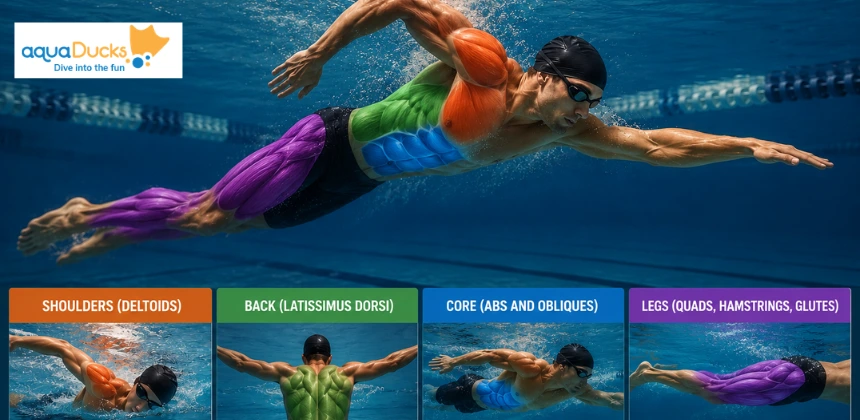
Shoulders (Deltoids): Your shoulders are heavily involved in every stroke. Each arm pull through the water activates the deltoids, and with consistent training, this is often where early muscle definition becomes noticeable.
Back (Latissimus Dorsi): Freestyle and backstroke strongly engage the lat muscles along your back. These muscles are responsible for pulling your arms through the water and are a key reason swimmers often develop a strong V-shaped upper body.
Core (Abs and Obliques): Your core stays active throughout the entire swim. It stabilises your body, controls rotation, and keeps you streamlined in the water. Unlike isolated ab exercises, swimming trains the core in a functional, continuous way.
Legs (Quads, Hamstrings, Glutes): Kicking drives lower-body strength. Flutter kick and breaststroke kick both work the quads, hamstrings, and glutes, with breaststroke especially activating the inner thighs and hips.
Overall, swimming trains the body as one connected system rather than separate parts, which is why it builds balanced, functional strength.
Which Swimming Stroke Builds the Most Muscle?
Not all swimming strokes are equal when it comes to muscle development. Here’s how they stack up:
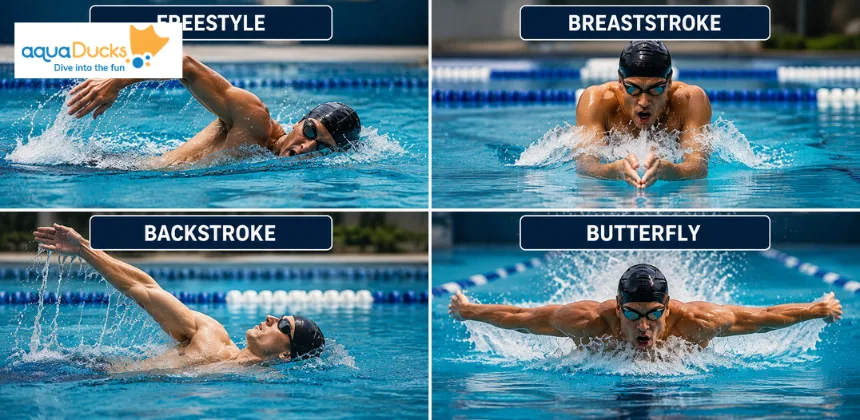
Freestyle
The most popular stroke, and for good reason. When you swim freestyle, you activate your lats, shoulders, triceps, core, and legs all at once. It’s one of the most efficient full-body workouts in the pool and the best starting point for beginners focused on overall muscle development.
Breaststroke
The go-to stroke at most public pools in Singapore is breaststroke swimming. It’s comfortable and manageable. What surprises people is how hard the legs are. The frog kick engages your inner thighs, glutes, and quads through a wide range of motion, making it one of the better strokes for lower body conditioning.
Backstroke
If your posture is suffering from long hours at a desk, something most working Singaporeans know all too well, backstroke is your fix. It builds the rear deltoids, traps, lats, and triceps while opening up the chest. It counteracts the forward-hunching effect of sitting at a screen all day.
Butterfly
The hardest stroke to learn, but the highest return on effort. Butterfly demands enormous power from your chest, shoulders, upper back, and core simultaneously. The dolphin kick also builds serious hip flexor and glute strength. If you can do a butterfly, your entire upper body will show it.
Swimming vs Gym — Which Builds More Muscle?
Let’s be honest and keep it simple.
- Swimming: Better for overall conditioning, endurance, full-body strength, and joint-friendly training. It improves strength, posture, and overall fitness without placing heavy stress on the joints. Many people also choose swimming for weight loss because it burns calories effectively while improving strength and endurance.
- Gym: Better for raw muscle size and hypertrophy. Weight training allows progressive overload, meaning you can keep increasing resistance over time, which is essential for building bigger muscles.
Best approach (recommended):
- Combine both for maximum results
- Swim 3–4 times a week for endurance, conditioning, and fat loss
- Gym 2 times a week, focusing on compound lifts like pull-ups, rows, squats, and overhead presses
This combination gives the most complete muscle development and works especially well with access to ActiveSG pools and affordable gyms in Singapore.
How Often Should You Swim to Build Muscle?
Consistency is the whole game here.
Three to five sessions per week is the sweet spot for meaningful muscle development. Any less and your body doesn’t get enough stimulus to change. Any more without adequate rest and recovery suffers.
Each session should be 30 to 60 minutes. A focused 45-minute session with varied strokes and intensity will do far more for your muscles than an hour of casual splashing.
Progressive overload matters in the pool, too. Your muscles only grow when they’re challenged beyond what they’re used to. In practical terms, that means gradually swimming faster, covering more distance, reducing rest time between sets, or adding resistance tools over time. If you do the exact same 20 laps at the same pace every week, your body will stop adapting.
Tips to Build Muscle Faster With Swimming
Small changes in how you train can make a big difference in muscle growth:
- Use paddles and fins: Paddles increase resistance on your upper body, especially shoulders and lats, while fins add intensity to your kicks and leg strength.
- Do sprint intervals: Swim short distances at maximum effort, rest briefly, and repeat. This pushes your muscles harder than steady laps.
- Rotate your strokes: Don’t stick to freestyle only. Mixing strokes helps you train different muscle groups and avoid imbalances.
- Add dryland training: Simple exercises like push-ups, pull-ups, and planks improve swimming strength and support better performance in the water.
Conclusion
Swimming builds real muscle that improves strength, coordination, endurance, and overall fitness. It won’t create a bodybuilder-style physique, but it can noticeably improve muscle tone, posture, and athletic performance over time.
In Singapore, it’s also one of the most accessible workouts. With ActiveSG pools, condo facilities, and neighbourhood swimming centres, staying consistent is realistic. The key is simple, show up regularly and swim with purpose.
Three to five sessions per week, mixed strokes, proper intensity, and enough protein are enough to see real progress. And if you’re still asking, can swimming build muscle? The answer is yes, especially with consistent training and good technique.
For faster and more effective results, working with a certified coach through private swimming lessons can sharpen your technique and make every session count.
FAQs
1. Does swimming make you bulky?
No. Swimming mainly develops toned, well-defined muscles rather than large muscle size. The resistance water provides isn’t high enough to trigger the kind of hypertrophy that makes muscles dramatically larger. You’ll look more defined and athletic, not bigger.
2. Can beginners build muscle fast with swimming?
Beginners actually respond very well to swimming because their bodies aren’t used to the resistance. You’ll notice strength and endurance improvements within the first two to four weeks, and visible muscle tone changes within six to eight weeks of consistent training.
3. Is swimming better than running for muscle building?
Yes, by a fair margin. Running builds some leg endurance but does very little for your upper body. Swimming activates nearly every major muscle group in the same session, making it significantly more effective for overall muscle development.
4. How long before you see results from swimming?
Strength improvements typically show up within two to four weeks. Visible changes in muscle tone, broader shoulders, a flatter core, and more defined arms usually appear around the six to eight week mark, provided you’re swimming consistently and eating enough protein to support recovery.