
Ask a few adults why they can’t swim, and you’ll keep hearing the same answer. “I missed my chance as a kid.” As if there’s an age limit. There isn’t.
But lots of people still believe it. Does this sound like you? It’s Saturday at the condo pool. The kids are splashing, and a friend keeps waving you in. You’re the one holding the towels, saying you’re happy to watch.
Plenty of Singapore adults do this for years. Most feel too shy to tell anyone. That’s a lot of Saturdays spent watching.
The benefits of swimming lessons for adults are bigger than most people think. You learn water safety skills and get a workout that’s easy on your knees. Feeling shy? Beginner classes are made for people just like you, and a good coach starts you in the shallow end.
Next time someone waves you over, maybe you go.
7 Benefits of Swimming Lessons for Adults
Swimming lessons give adults water safety skills, a joint-friendly workout, and a way past the fear of water. They can also help your heart, make family pool time safer, and let you join in on beach holidays.
1. Water Safety Skills for Real Life
Being able to “sort of swim” isn’t the same as being safe in the water.
Singapore loses nearly 20 people a year to accidental drowning. Sport Singapore has reported that most cases happen in the sea, rivers and reservoirs, not in pools. Out there, there’s no wall to grab, and currents (moving water that pulls you along) can carry you off.
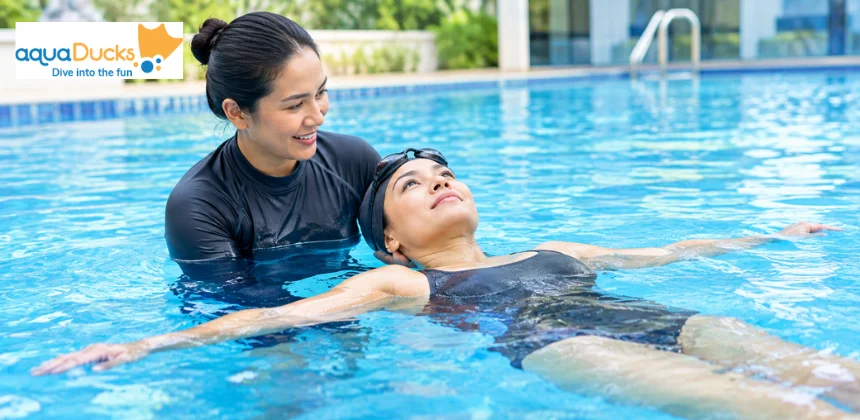
A coach teaches the skills that matter when something goes wrong. You learn to float on your back so you can rest. You learn to tread water, which means staying upright in deep water by gently moving your arms and legs. You also practise staying calm.
No lesson can promise you’ll never get into trouble. These skills just give you more ways to handle it.
2. Being Able to Help Your Kids in the Water
Most condo pools in Singapore don’t have a lifeguard. A study by SGH and SCDF looked at drowning cases in Singapore pools and found that 72% happened in private pools, most with no lifeguard there. Children under 10 made up the biggest group.
With no lifeguard, you’re the lifeguard. That’s hard to do from the side if you can’t swim. Lessons teach you to get into deep water, reach someone, and keep your own head up.
Close supervision still comes first. The Singapore Heart Foundation lists it alongside swimming skills as key ways to prevent drowning. Swimming doesn’t replace watching your kids. It means you can act quickly when you see something.
Does a helper often take your kids to the pool? It’s worth making sure she can swim too. Swimming lessons for domestic helpers are built around exactly that. They focus on water safety and supervising children in the pool, not competitive strokes. Ask if female instructors or lessons in her own language are available; it makes a real difference for someone who’s never been in a pool before.
3. A Low-Impact Workout That’s Kind to Your Joints
Running on hard pavement jolts your knees and hips with every step. In water, most of that pounding disappears.
The reason is buoyancy, the upward push water gives anything in it. It’s why a beach ball pops back up when you push it under. In water up to your neck, buoyancy holds up about 90% of your body weight. That’s what makes swimming a low-impact exercise: a hard workout without the strain on your joints.
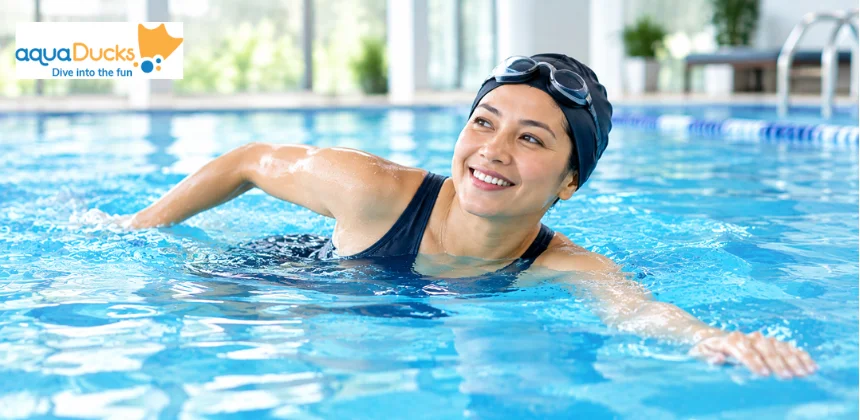
Water also pushes back on every move. This push is called resistance, and it works your arms, legs, back and tummy at once. And in Singapore’s heat, it beats a sweaty 6pm jog.
Lessons help here too. Beginners often lift their heads and kick hard, which wears them out fast. Good technique spreads the effort across your body.
If you mainly want gentle exercise for stiff joints rather than learning strokes, look for a dedicated water fitness or aqua-aerobics programme rather than a standard swim class. These low-impact water workouts help adults and seniors build fitness and mobility, which means how easily your joints move.
One catch: because water carries your weight, swimming doesn’t seem to do much for bone strength. Add some strength work on land at least twice a week, as Singapore’s physical activity guidelines suggest. And if you have a heart condition or an injury, check with your doctor first.
4. A Stronger Heart, and Possibly a Longer Life
Swimming is cardio, short for cardiovascular exercise. That means it works your heart and blood vessels, the tubes that carry blood around your body. Like any muscle, your heart gets stronger with regular use.
The research looks good. A large review of studies covering 2.6 million adults found swimmers had a 24% lower risk of dying early from any cause. A Swim England report also linked swimming to a 41% lower risk of dying from heart disease or stroke.
These studies show a link rather than proof, since swimmers may have other healthy habits too. Even so, it’s a strong sign. And if your knees can’t handle running, swimming is often the cardio you’ll actually stick with.
The key is to keep moving. If you stop every few metres, your heart barely works. Lessons build the breathing and stroke skills for steady laps. Three 45-minute swims a week get you close to the 150 to 300 minutes Singapore’s guidelines recommend.
5. Overcoming Fear of Water, One Small Step at a Time
For many adults, fear is the real reason they never learned. Research shows fear of drowning holds people back more than money or pool access does.
Fear is physical. When you’re scared, your muscles tense and you hold your breath. A stiff body sinks, while a relaxed one floats, helped by the air in your lungs. That’s why some people can’t float until they learn to relax.
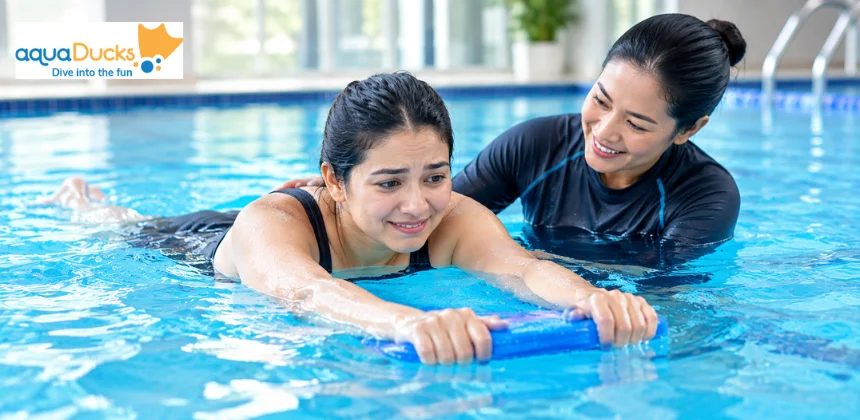
Good adult lessons never rush you. You might start by standing in waist-deep water. Then you blow bubbles, put your face in, and float with a coach’s hand under your back. Each step feels small, but they add up.
Breathing is a big part of it. Beginners often hold their breath underwater, then panic when they need air. Coaches teach you to breathe out slowly as bubbles, so you’re ready to breathe in when your mouth comes up. For simple drills to try, here’s how to breathe while swimming without the panic.
For about 2 to 3% of people, the fear is aquaphobia, a strong, lasting fear of water. One-to-one lessons may suit them better at first. And if you had a scary moment in water as a child, tell your coach on day one. It helps them plan each step around you.
6. Holidays Where You Get to Join In
Bali, Phuket and Langkawi are short flights from Singapore. But if you can’t swim, you end up on the boat while everyone else snorkels.
Scuba diving even has a swim test. For a PADI Open Water certificate, a popular beginner course, you need to swim 200 metres without stopping. Any stroke counts, and there’s no time limit. You also need to float or tread water for 10 minutes.
Lessons build the stamina to make that feel doable. If you have a trip coming up, tell your coach the date so you can plan around it.
7. A Calmer Mind and a Bit of Company
Swimming makes you breathe slowly and steadily, in time with your strokes. That kind of slow breathing helps calm your body down. There’s also no phone in the pool. For 45 minutes, nobody can reach you.
Group lessons add something else: company. You’re in the water with other adults who are learning too, so nobody’s the odd one out. And a class booked at the same time every week is much harder to skip than a swim you “might do later.”
Learning something that used to scare you feels good, too. It’s a small win you carry out of the pool.
How to Choose Adult Swimming Lessons in Singapore
Group class or private coach? Public pool or swim school? The right pick comes down to three things: how you feel about water, your budget, and how soon you want results.
Here’s how the three main options compare.
| Factor | ActiveSG group class | Swim school group class | Private one-to-one |
| Cost | Lowest | Middle | Highest |
| Class size | Bigger groups | Smaller groups | Just you and the coach |
| Pool | Public pools, mostly outdoor | Varies, and some are indoor and heated | Depends on the school |
| Timing | Fixed class times | More time slots to pick from | Most flexible |
| Pace | Set by the group | Set by the group, with more help | Set by you |
| Best for | Budget learners who are already fairly relaxed in water | Most beginners who want guidance and company | Nervous learners, or anyone with a deadline |
Nervous About Water? Start With Private Lessons
If a group class sounds scary, go one-to-one first. The coach focuses only on you. There’s no one to keep up with and nobody watching. Some schools also offer semi-private lessons for two, so you can learn with a partner or friend.
Warm water helps too. Cold water can make you tense up, and tense muscles make floating harder. An indoor, heated pool can make those first lessons a lot easier.
Once you can float and put your face in without panicking, you can move to a group class to keep costs down.
Want Company Without the High Price? Try a Group Class
ActiveSG classes at public pools cost the least. They suit you best if you’re already fairly relaxed in water. Groups are bigger, so each person gets less of the coach’s time.
For most beginners, a smaller group at a swim school is the better balance. Look for classes that start with water familiarisation. That just means getting used to the water by standing, breathing and floating before you learn any strokes. A school with clear levels also means you won’t need to switch schools as you improve.
Got a Deadline? Go Private
Maybe you’ve booked a dive trip. Or you’ve promised your kids you’ll swim with them by the school holidays. One-to-one lessons usually get you there faster, because the whole lesson is spent on you. Each lesson costs more, but you may need fewer of them.
One last tip: pick a pool near your home or work. The easier it is to get to, the less likely you are to skip.
Why Learn With AquaDucks?
We’ve taught swimming in Singapore since 1989, and the International Swim Schools Association has recognised our teaching with its Pedagogical Pioneer Citation Award. Our adult classes start at Level 1, where you get comfortable in the water before learning any strokes. Every lesson takes place in an indoor, heated pool with a certified coach. If you’d rather start one-to-one, private and semi-private lessons are available too.
Book your trial lesson with a certified coach at the venue closest to you. One lesson, no long commitment.
Conclusion
The benefits of swimming lessons for adults reach well past the pool. You build skills that help keep you and your kids safer. You get exercise that’s easy on your body. And you finally get past an old fear.
The water doesn’t care how old you are. What matters is choosing a start that fits how you feel about it. Go private if you’re nervous, or join a small group if you’d like company..
FAQs
What should I bring to my first adult swimming lesson?
A swimsuit, goggles and a swim cap. Pack a towel and a bottle of water too, because you can get thirsty in the pool without noticing. If your goggles are new, try them on at home first, so you’re not fiddling with the straps in the water. And skip a big meal in the hour before your lesson.
How long does it take an adult to learn to swim?
Usually 8 to 12 weeks of regular lessons. By then, many beginners can float, breathe properly and swim a short distance on their own. Swimming 200 metres nonstop, like the scuba test, often takes longer. How often you practise and how nervous you are at the start make the biggest difference.
Is swimming good for weight loss?
Yes, but it isn’t a shortcut. Harvard Health puts 30 minutes of general swimming at around 216 calories for a 70 kg person, about the same as a light jog. Beginners usually burn less, since they stop often while learning. What you eat still matters more for losing weight.
How often should adults take swimming lessons?
Once or twice a week. Skills like breathing and floating tend to slip when weeks go by between lessons. If you can, add one short practice swim in between, in the shallow end and never alone.
Can adults teach themselves to swim?
Yes, but it’s slower and riskier than learning with a coach. Videos can show you what a good stroke looks like. They can’t tell you your head is too high or that you’re holding your breath, two common beginner mistakes. Learn the basics with a coach first, then practise between lessons with someone nearby.