
The company retreat is in Desaru, and the itinerary says snorkelling at 10am. You’ve already worked out your excuse: a call to take, a sunburn to avoid, bags that need watching. If you’ve reached adulthood without learning to swim, you’ve probably become very good at excuses.
So, is it too late to learn to swim as an adult? No. Not at 30, not at 50, and not at 65 either.
Here’s where the doubt comes from. There’s a myth that swimming is a skill your body only picks up in childhood, like a door that locks once you grow up. It isn’t true. Adults walk into Singapore pools with zero experience every week and learn from scratch. Your body was never the problem. Nobody has shown you how yet.
And in Singapore, where condos, clubs and community centres all have pools and the beach is a short ride away, you’ll never be short of places to practise once you’ve started.
Why You’ve Been Holding Back, and Why Your Body Is Already Built for This
If you’ve been putting this off for years, you’re not lazy, and you’re not alone. Maybe you grew up around crowded public pools. Maybe one scary moment as a kid just stuck with you. Or maybe nobody ever taught you properly, and you’ve been quietly avoiding it ever since.
It helps to know your body isn’t actually fighting you here. The reason is buoyancy: water pushes upward on anything in it, so your body naturally wants to float instead of sink. Your lungs work like two balloons inside your chest. When you fill them with air, they push you upward, and that’s a big part of what keeps you up in the water. You already carry your own built-in life jacket. You’ve just never been shown how to use it.
One catch: a tense body tends to sink more than a relaxed one. Learning to relax in the water is the real skill, and it’s exactly what a good coach teaches first.
Adults also bring real advantages to the pool. You can follow instructions and focus on one small movement at a time, and you’re not competing with the wriggly, distracted energy a five-year-old brings to a lesson.
Your First Few Weeks in the Water
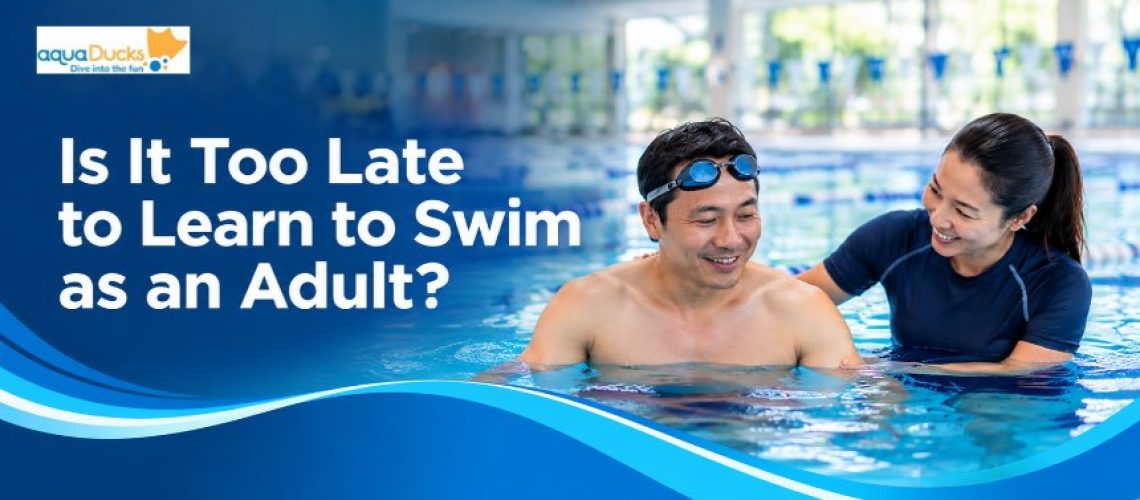
You won’t be thrown into anything deep. A proper beginner class starts in shallow water, so you can stand up whenever you need to, and your coach stays close, often with a hand nearby, so you’re never left to figure it out alone. That one detail takes the edge off for most beginners.
Every learner moves at their own pace, but the first month usually looks something like this:
Week 1: getting comfortable. You practise standing in the shallow end, putting your face in, and breathing out slowly through your nose and mouth. Tension, more than the water itself, is often what causes people to panic, so this is where you learn to stay loose. Many beginners finish the week able to put their face underwater without flinching. It sounds small, but it’s the biggest hurdle for a lot of adults.
Week 2: floating clicks. You float on your front and your back, with your coach supporting you at first and easing off as you stop fighting the water. For many adults, this is when their feet lift off the pool floor and they realise this might actually work.
Week 3: your first real movements. Holding a kickboard, you practise a simple kick and basic arm movements, building muscle memory piece by piece.
Week 4: it starts to connect. Kicking, floating and breathing begin to join up, and you cover a few metres with a board or light support.
From there, most adults need around 8 to 12 weeks of regular lessons before they can float, breathe properly and swim a short distance on their own. How often you practise and how nervous you are at the start make the biggest difference.
Want each skill broken down in more detail? Our beginner’s guide to how to swim covers the technique step by step, and our adult swimming classes show how it plays out in a real lesson.
Does Your Age Change Anything?
Less than you’d expect. Age mostly affects how quickly you settle in the water and what your coach needs to know about you before the first lesson.
In your 30s, the push often comes from having young kids and wanting to get in the pool with them on weekends. Your body won’t hold you back. Finding a regular time slot for lessons usually takes more effort than the swimming itself.
In your 40s, a lot of adults start because running has begun to bother their knees, or their doctor has suggested something low-impact. You’ll pick things up at roughly the same speed as someone ten years younger. You may just feel a bit more nervous in the first lesson, since you’ve spent longer avoiding the water.
From your 50s, stiffer shoulders and hips can make some strokes slower to get right. The early goals don’t need much flexibility, though. Floating, breathing calmly and getting yourself back to the wall are all within reach, and your coach can adapt a stroke to the way your body moves.
In your 60s and later, expect the first few stages to take a little longer, and don’t let anyone rush you through them. If you have a heart condition, high blood pressure or a recent injury, check with your doctor before you start. If gentle exercise for your joints is what you’re really after, our AquaFit programme may suit you better to begin with.
If You Panic Along the Way
Panic happens, and a good school will tell you that upfront instead of pretending it won’t. Adults tense up, swallow water, or freeze halfway through a movement, and a coach trained for adult beginners expects this. They’ll pause, help you back to standing or to the wall, and let your breathing settle before continuing, on your terms rather than a schedule.
If breathing is the part that worries you most, our guide to swimming breathing technique goes deeper into how to stay calm in the water. And if a coach seems impatient with fear, that’s worth noticing. It’s not a sign you’re bad at this.
By the time you’re a few lessons in, this whole sequence starts to feel less like steps to remember and more like something your body just knows.
Why It’s Worth Starting Now
Learning later changes more than your weekends. You get safer pool time with your kids, holidays where you join the snorkelling instead of minding the bags, and low-impact exercise that works in Singapore’s heat. We cover all of it in our full guide to the benefits of swimming lessons for adults.
How to Pick a Class When You’re Starting From Zero
Not every class suits a nervous first-timer, and the wrong one can make an already big step feel worse. Three things are worth checking before you sign up:
A small class. With two or three adults, your coach can watch your breathing and notice when you start to tense up. In a group of ten, you’re mostly on your own.
A coach who regularly teaches adult beginners. Teaching a nervous 35-year-old is a different skill from teaching a confident eight-year-old, and it shows in how patient and specific the coaching feels.
A shallow-water start. If a school’s first lesson goes past chest height, they haven’t adjusted their approach for adult beginners.
Conclusion
So, is it too late to learn to swim as an adult? No. It never was. The only thing standing between you and the water has been the first step, not your age, your body, or how long you’ve put it off.
The embarrassment, the panic, the not knowing where to start: a good coach has seen all of it before and knows how to handle it. You don’t need to arrive confident. You just need to show up once. aquaDucks has been a swimming school in Singapore since 1989, and the International Swim Schools Association (ISSA) has recognised our teaching with its Pedagogical Pioneer Citation Award, so your first lesson is in experienced hands.
When you’re ready, book a trial lesson at the venue closest to you. No pressure, no judgment, just one coach ready to help you take the first step at your own pace.
Frequently Asked Questions
Am I too old to learn to swim at 60 or beyond?
No. Age isn’t the barrier. Pace and comfort are. A good coach starts you in shallow water, moves at your speed, and adjusts for stiff joints or past injuries, so tell them about any health conditions on day one. If you have a heart condition or an injury, check with your doctor first. If gentle, low-impact exercise is your main goal, ask about our AquaFit programme.
Can I learn if I can’t float?
Yes. Many people who think they “just sink” are simply tense, and a tense body sinks faster. Some people do float more easily than others, but floating comfortably is a skill your coach can teach. They’ll support you at first, using kickboards and floats if needed, until you can let go. Back floating usually comes first because it’s the easiest to settle into.
What if I’ve tried to learn before and gave up?
This is more common than you’d think, and it usually means the approach wasn’t right for you, not that you’re incapable. Many adults who “failed” before were taught too fast, pushed into deep water too early, or paired with a coach used to teaching children. The right pacing and the right coach change everything.
Can I still work toward a SwimSafer certificate as an adult?
SwimSafer 2.0 is Singapore’s national water safety programme. If you’re not doing it through a primary school, you can learn the SwimSafer stages with an accredited instructor, who also registers you for the assessments. If you’d like to work towards it, mention it when you book your trial and we’ll let you know what’s available at your venue.